Return to a Modest Foreign policy

Did DeSantis revive the Weinberger doctrine in his interview with Tucker Carlson at the Family leadership summit?  Just a remainder, those principles were:

1. Forces should not be committed unless the action is vital to national interest.

2. Forces should be committed wholeheartedly with the intention of winning – or they should not be committed at all (No half-hearted commitment).

3. Forces should be committed with clearly defined political and military objectives.

4. The use of force should be the last resort (after all diplomatic initiatives have been exhausted).

5. The relationship between objectives and the force committed should be continually reassessed and adjusted if necessary.

6. Before committing forces abroad (in foreign countries) there should be some reasonable assurance of public support.

DeSantis mentioned in his interview that the lessons he learned from his experience in the Middle East that you needed a concrete end game, and he criticized that the present foreign policy establishment failed to detail an endgame in Ukraine.  He added that they should be concerned about the southern border.  His own stated goal is a sustainable peace in Europe and details a path to that. (But he did not elaborate on how to but this format was conducive to a more in depth details.)  He added that China is the number threat and is indicating he would concentrate on dealing with China just as Reagan number one objective was the Soviet Empire.   Like Trump he would force Europe to spend on their defense.  Would be interested how DeSantis view Polish government own increase spending and the biggest land army in Europe and their economy has been growing and prepared to surpass Great Britain in 2030.  How would President DeSantis deal with Poland and other nations in Central Europe.)

DeSantis made it clear that whether military support or the imposition of troops in foreign lands must have clear objectives and his criticism of recent past in our policies in Iraq and Afghanistan dealt with changing objectives from stopping Weapons of Destruction and evolving into nation building which in Afghanistan failed.  He is talking a return of modest foreign policy that George W. Bush campaigned in 2000 and before 9/11. As the campaign continues, we will see more details about his foreign policy will surface but for now, he is following a more modest policy with China his number one threat.

Ennis Wins a big bout

By Tom Donelson / Member Boxing Writers Association of America (BWAA)

Jaron Ennis look to stay undefeated against Roiman Villa and defend his interim IBF world welterweight champion.  Roiman Villa was full of confidence, but it did not take long for the notion of Villa being in the same league as Ennis ended quickly as Ennis simply used his quick hands to dominate the fight.  Over the first two rounds, Ennis landed thirty-six punches to Villa’s two.  Villa did not even strike a blow in the second round and Villa kept coming forward despite a bloody nose.  Ennis used quick right hooks off his southpaw and Villa often missed Ennis with a wide shots.  From this point, it was obvious that Ennis was in a different league than Villa .

Ennis doled out punishment from the opening bell and while he was extended past round seven for the second time in his career, it was an easy fight for Ennis.  In the sixth round, he buckled Villa as he connected a series of right hands, and while he had Villa in serious trouble, Villa stayed on his feet. 

He also nailed Villa with a left upper cut and hurt Villa in the seventh round.  The upper cut was an effective punch in the entire fight and in the tenth round he stopped Villa .

Ennis landed 227 punches versus only sixty-five punches for Villa, and he connected on 36 percent of his punches compared to only 14 percent for Villa.  Ennis landed more power shots and almost as many jabs compared to Villa’s total amount.  This was complete domination .

Ennis wants the winner of the Errol Spence Jr . versus Terrance Crawford bout for the King of the Welterweight division, and he certainly is ready to fight either one.  

Case Study Ali and Jones, jr

A Boxing Perspective

Tom Donelsonadmin

By Tom Donelson … Member Boxing Writers Association of America … and – long time honored contributor to http://www.dmboxing.com since 2008

I read an interesting piece about Muhammed Ali and Rocky Marciano.  The writer noted that Ali defensive skills were more due to his physical skills and speed to escape as opposed to his technical skill.  Rocky Marciano began his career as a strong fighter with a knockout punch and raw defensive skills . As he advanced, he learned the basics of defense and while he would never be considered a great defensive fighter, he developed enough skills to deflect punches while delivering knock out punches. 

When Marciano retired, he left undefeated and with no apparent brain injuries that could be detected; but as Ali got older, his speed left him and he became easier to hit.  His third fight with Joe Frazier was a war that shorten both men’s careers, and in his fight with Earnie Shavers, he took some massive shots.  The younger Ali would have avoided most of those punches, but the older Ali showed he could take a punch, but those punches took their toll.  By the time he finished, it was becoming apparent that he suffered injuries and would end up with Parkinson’s disease .

Roy Jones had a similar career to that of Ali.  Jones had a super-fast hand, and his defensive skills also had less to do with technical skills than his physical attributes.  After defeating John Ruiz for Ruiz’s version of the heavyweight crown, he was on the top of the boxing world but a close victory over Antonio Tarver in their first fight showed the first sign of decline . In his second fight with Tarver, he was knocked out in the second round and from that point, he was no longer the Roy Jones of old. 

He suffered a devastating knockout to Glen Johnson in his first fight after the Tarver loss, and lost a unanimous decision to Tarver in their rubber match.  When he was younger fighter, he easily beat Bernard Hopkins but later, in his declining years, Hopkins easily beat Jones . Hopkins was a solid technician who was able to have a successful career long into his forties as he rarely took a beating during much of his career.  

Hopkins learned the ABCs of defense and that allowed him to be one of the great middleweights . He never had the physical skills of Jones early in his career, but learning the boxing basics allowed him to continue his career and defeat Roy Jones in their second fight.

Throughout boxing, like other sports, physical skills can take a player only so far at the elite level of professional sports, for even the most skilled athletes are competing with other top athletes and learning the basic skills can add to an athlete’s career.  Great boxers often depended, not only on just basic physical skills, but also learning the basics. Learning the basics will allow the boxer to have a longer and more successful career. Larry Holmes’ basic boxing skills allowed him to be competitive with younger fighters into his forties and he even fought Evander Holyfield for his title while losing a unanimous decision.  (It is interesting that George Foreman did win a title at 45 against Michael Moorer and in his reincarnation after a decade layoff, he added some additional defensive skills. Just like Marciano, Foreman was not great defensively, but he picked up enough skills to compete with younger fighters.)

Grand Strategy

In April of 2020, 20,000,000 people were thrown out of work due to the lockdowns, which will prove to be one of the biggest economic disaster the United States government ever imposed on its citizens.  From the time that Pandemic began to the present, Republican states outperformed their Democratic counterparts when it came to lower unemployment and job creations.    Regardless how you rated how Republican governors compared to their Democratic counterpart or whether you reviewed states that were controlled by one party, the results were the same, Republicans outperformed Democrats.

Among Republican governors, their states returned 102.91 of jobs lost from the pandemics and their Democratic counterpart returned 100.81 percentage of their jobs.   Republicans’ governors made up 80 percent of the top ten states and 68 percent of states in the upper half of states in returning jobs from the pandemic. This reinforces the notion that GOP governors proved better at job creation.   Eighty-five percent of Republican governors reached 100 percent or more of jobs returned versus only 58 percent of Democratic governors.

Then we looked at states where the Republicans controlled both the legislature and the governor seat to their Democratic counterpart, we saw similar results as Republican states returned 103.08 jobs from pandemics compared to 100.35 for Democrats.  Eighty-seven percent of GOP states returned 100 percent or more compared to 53 percent for Democratic states.  We did find that states that have mixed government outperformed states with Democrats control and slightly under GOP states.  Seventy-five percent of mixed states returned 100 percent or more jobs from the pandemic and 102.31 percent jobs were returned. 

We have found that in previous research that Republican states had lower unemployment than their Democratic counterpart in the December of 2022 and then we continued to follow up and so far, we have found Republican states with Republican governors or Republicans complete control of all levers of government have lower unemployment than their Democratic counterpart in the latest unemployment released by Department of Labor. 

A Story of Eight States

How does Illinois, Pennsylvania, New York, and California compare to Florida, Georgia, Texas, and Ohio when it comes to job production and growth? These are the eight most populous states and four have Democratic governors and four have Republican governors. These states were similar in demographics and blue states do have an advantage as they have slightly more Asians who consistently have unemployment similar or lower than Whites and these states population was slightly younger.

What we found was that these GOP states outperformed their Democratic counterparts, and this matched national trend.

In December 2022, these GOP states had an average unemployment 3.4 percent versus 4.2 percent for Democrats states and in May of 2023, GOP states had an unemployment number 3.4 percent to Democrats 4.1 percent. One reason that GOP states outperformed their Democratic counterpart was that they opened earlier, and, in the winter of 2020, three of the four GOP states did not re-lockdown their economy and kept their schools open.

Another aspect is that all the GOP states by May 2023 replaced those jobs lost from the pandemic’s lockdown for an average of 104.94 percent jobs returned and only two of the four Democratic states recovered all those jobs and the average for those Democratic states was 100.23 percent. This simply demonstrated what we saw on a national average that GOP states outperformed their Democratic counterparts with lower unemployment and returned jobs quicker from the pandemic losses.

In 2022, these Republican states had 2.9 percent GDP growth compared to 2 percent for Democratic states. And in the first quarter of 2023, these four Republican states averaged GDP was 2.55 percent versus Democratic states at 1.15 percent.

Since 2020, these GOP states consistently outperformed their Democratic counterparts. Two of the four GOP states had lower unemployment than the national average, but all the Democratic states were above the national average. All the GOP states also were able to recover all their jobs from the pandemics whereas only two of the four Democratic states were able to do this. The lower unemployment simply supports why GOP states did recover all their jobs quicker.

Finally, these four GOP states had GDP growth more than double than their Democrats counterparts in the first quarter of 2023 and this is also reflective in the better jobs report. And this continued a trend from the previous four quarters in which the Republican states outperformed their Democrat counterpart by a third more in economic growth.

Florida vs California

A good piece in Brownstone Institute detailed how Florida outperformed California in all aspects from education, economics, and overall health care during the Pandemic.  Brownstone researcher Josh Stevenson observed that having a job not only impact a person economic outlook but also their health as he observed, “The cost of destroying livelihoods has impacts on health and life expectancy.. This was well-established in Public Health yet was constantly ignored by lockdowners. Knowing that the lockdowns completely failed to prevent or even reduce Covid spread and mortality, it was clear by mid-2020 that there could only be net harm by adding economic hardship onto the already existing burden of the virus itself.”

Galvin Newsome views himself as the best governor when it comes to leading California through the pandemic and defended the Fauci’s narrative but the reality, the economic outlook of his state declined and many of his state citizens now live in Texas and Florida.  There is a wealth of data showing the complete failure of the lockdowns. Josh Stevenson reported in his research that while Florida increased their overall employment from January 2020 by 3.2 percent, California remained 11.5 percent below their pre-pandemic levels. This is verified by other data as we found Florida along with GOP and southern states did a better job replacing their workforce from the lockdowns.

Casey Mulligan, Phil Kerpen and Steven Moore reviewed in a recent paper the metrics dealing with Health care, economic, and education, found Florida came in at sixth place compared to California ranking only forty-seven.  Regardless of what Metrics you use, Florida outperformed California and Florida also outperformed New York.

Florida has 13 percent more population, so New York spends 2.24 times higher on a per capita basis and as Francis Menton of Manhattan contrarian observed, “The theory here must be that the extra spending improves the health outcomes of New York’s poor and other low-income residents. How can we measure that? Healthcare outcomes are subjective and often not subject to definitive metrics. But one thing that can be measured and directly compared is life expectancy. Surely, for almost 4.5 times the per capita state Medicaid spending as Florida, and with almost 40% of the population participating in the Medicaid program, New Yorkers must have demonstrably longer life expectancy than Floridians…In January 2023 the online pharmacy Nice RX came out with a study of life expectancy by state, using CDC data for the year 2020. And the results are New York 77.7 years; Florida 77.5 years. It is an almost imperceptible difference. This is beyond embarrassing.”

Menton also compared education spending and results as New York state pays out nearly 14,000 dollars per student compared to $8543 per student in Florida.  Menton observed that “The summary is that Florida students did substantially better in two categories, New York students better in one category, and the fourth category was essentially a tie. For this, does New York pay double and more what Florida pays? Again, it is shocking…And dare I mention that, with the far lower spending, Florida gets along just fine without any income tax at all? All I can say is, it is no wonder that Florida continues to grow its population rapidly, while New York shrinks.”

I live in Iowa, and I hear the ads, but Ron DeSantis is not talking about this impressive record.  He is not yet working to his strength, his stewardship of the economy during the Pandemic and getting children educated when the prevailing policy was to keep the school closed.  He was an island of sanity and competence when others failed on both. The biggest weakness of Trump years was Trump’s handling of the pandemic as he allowed Dr. Fauci and Dr. Birks hijacked the management of the virus while undermining Trump administration with promoting the lockdown that ensured Trump political demise in the 2020 election.  The one thing that Trump did right was to allow the federalist approach and because of this, many of those Republican states who opened the economy earlier provided the brunt of the economic growth that occurred in the second half of the 2020.

From May 2020 to December 2020, 1.5 million jobs per month were returned to the economy and this represented more than half of the jobs lost in the pandemic. It took Biden administration about two years to capture the rest of the jobs.   Red States including Florida kept the economy afloat and led what economic recovery moving into 2021.  This is the story that we do not hear, how Florida and other states including Iowa led the economic recovery while many Democratic states like California and New York preferred to close their economy and allow their people suffer to defeat Trump. DeSantis showed both competence and the wiliness to challenge the political establishment when they were obviously wrong and kept the economy going. DeSantis was right, the Democrats, the Deep State and even Trump proven wrong.  Iowa followed his lead and Iowa also outperformed many Democratic states.  That is one story that needs to be told. Competence in crisis.

The Final Battle

We are now in the final battle as a movement to identify what conservatism will be in the 21st century and be able to turn this nation around.  The future of conservatism is to combine Trump populism with Reagan conservatism.  The battle is between the populist conservatives and more traditional conservatives.   Dominic Pino detailed this recently, “For decades, tax cuts have been at the center of the conservative economic agenda. But some on the right want to deprioritize them in favor of other economic goals. Senators Marco Rubio, Josh Hawley, J. D. Vance, and others talk of the need for a new Republican economic agenda focused on things such as industrial policy or social policy. The Trump administration sought to increase tariffs, and conservative defenders of protectionism are being more vocal…Tax cuts seem to irk some right-wing commentators. In May 2020, writing for the American Conservative, Michael Cuenco bemoaned the Tax Cuts and Jobs Act (TCJA), the 2017 tax-cut law that Donald Trump signed, and called for a “reformulation of fiscal policy along populist economic nationalist lines.” He wrote, “The reformist right should ask: is there any way to stand athwart the supply-side swamp yelling Stop?”

I made the case that the importance of supply side economy and that its definition must be expanded in my book, “Americas at the Abyss, will America survive?” I made the case that government spending must be controlled, regulations burden reduced, and supply side had to move beyond just tax cuts. Trump did two of three, reduce regulation and tax reduction which benefited most Americans. The result was continuation of the recovery and more importantly the middle class, minorities, and lower income saw their income increase.  Economic growth matters but Trump failure to get government under control hurt his overall economic plan and the massive spending during the Covid pandemic along with the anti-growth lockdown hurt the economy in 2020 and ended Trump chances to win. 

Pino noted that GOP governors are pursuing tax reductions and yet, they are conscious of making sure that they keep spending under control as not to repeat what Brownback did in Kansas, cut taxes but failed to cut spending accordingly.  The new generation of governors are doing both while not just cutting taxes but trying to flatten taxes. 

The United States is in the middle of the tax-reduction revolution on a state level and as Jared Walczak of Tax Foundation, observed, “The past three years have seen the largest wave of state-tax cuts in the modern era, certainly since income taxes were created over a century ago at the state level. We have seen more than half of the states with income taxes cut their top rates. We have seen trimming of rates in other taxes, including thirteen states with corporate-income-tax cuts, a couple of states with sales-tax cuts, and trimming other taxes as well.” And these states are enacting real tax reforms.

There are seven states that do not tax individual income including Alaska, Florida, Nevada, South Dakota, Tennessee, Texas, and Wyoming.  New Hampshire taxes only interest and dividends but are phasing them out so there will be eight states no tax.  Governor Burgum of North Dakota noted recent legislation in reducing taxes will move North Dakota toward a goal of no state income tax and Iowa Kim Reynolds is following a similar pattern. Mississippi Governor Tate Reeves attempted to be rid of the income tax, but the legislature chose a flat tax with reduction.  Tax Foundation Walczak favored the legislature caution as he noted, “Some proposals have overreached, but lawmakers have either defeated those proposals or substantially curtailed them before enacting them,”

When Kim Reynolds did her tax reforms, these principles were considered as government spending were slowed while lowering the tax rates. Iowa house speaker pro tempore John Wills observed about the Reynolds reform “We were looking at being very cautious and being very conservative, I guess you could say, in our approach, so that if at any point the revenues weren’t coming in as projected, we could back it off. That is why the cuts are designed to step up over several years.”   The state replaced its top rates 8.53% and nine brackets to 6% and four brackets and the different brackets will be eliminated each year until the 3.9% flat tax is reached, subject to revenue triggers. For many Midwestern Republicans do not want to copy is first Illinois and for many Iowan Republicans, they realized their top rates were higher than Illinois and that was a wake-up call. The second is to not copy the Kanas model for when Brownback signed huge tax cuts with the idea of boosting economic activity, but budgetary shortfalls occurred as tax revenues increases did not materialize, and budget shortfall occurs. This led to Democrat Laura Kelly to be elected in 2018 and re-elected in 2022. Republican politicians are taking a more caution approach and controlling government spending.

Which leads us to the future of the GOP as Republican governors are looking to control their budget and return money back to the taxpayers.  As I mentioned in a previous piece, Florida has been providing essential services for one half the cost as Democratic states like New York and do not have a state income tax.  For the GOP, the key will be combined the best of Reagan ideas with Trump populism which Trump did in his administration.  A modest foreign policy combined with tax and regulation reduction were the hall mark of the Trump years and the Republican candidate who can combine these two principles and add spending restriction can win the White House.

References

Where Tax Cuts Are Hot | National Review

Florida vs California – by Tom Donelson/ F of F (substack.com)

Substack Home – Frontier of Freedom notes and research

Substack Home – Frontier of Freedom notes and research

Leaving blue paradise – by Tom Donelson/ F of F (substack.com)

Once Again, State Budget Time in New York And Florida — Manhattan Contrarian

America at the Abyss, Will America Survive by Tom Donelson

Weinberger thesis

Toward an American First Policy

For advocate of an America’s First foreign policy might begin reviewing the former Secretary of Defense Cap Weinberger six rules for engagement.  The principles were:

1. Forces should not be committed unless the action is vital to national interest.

2. Forces should be committed wholeheartedly with the intention of winning – or they should not be committed at all (No half-hearted commitment).

3. Forces should be committed with clearly defined political and military objectives.

4. The use of force should be the last resort (after all diplomatic initiatives have been exhausted).

5. The relationship between objectives and the force committed should be continually reassessed and adjusted if necessary.

6. Before committing forces abroad (in foreign countries) there should be some reasonable assurance of public support.

Casper Weinberger set these principles in the aftermath of the Vietnam war in which America was divided and there was serious question on how the war was conducted, so he set in principle ideas that political leader needs to consider.  In 1984, two events occurred, one in which 240 Marines were killed as result of a suicide bomber in Beirut and the second, the invasion of Grenada in which United States removed a Marxist government that overthrew another leftist government and supported by Cuban forces.

The Beirut attack was part of an ill-defined peace keeping mission in Lebanon and eventually Reagan, left Lebanon as oppose to getting sucked into an endless morose and in Grenada, United States went into with overpowering force, and easily removed the Cuban forces in an island in our backyard, the Caribbean. 

The first Gulf War was influenced by this principle as United States and their alliance went into Kuwait with overwhelming force, defeated the Iraqi army easily before ending the war.  And Bush administration went to the American people and Congress to gain approval to use force if diplomacy failed in persuading Hussein to leave Kuwait.  After the failure of diplomacy, the first Gulf War commenced. 

The second Gulf War and the war on terror began with these principles but after the initial victory, the United States expanded upon the objectives in Iraq and Afghanistan to reinstitute democratic government in both countries.  From there, United States engaged in long term engagement that ended in failure in Afghanistan. 

The question is how to use these principles in the future to protect American national interest and not lapse into an isolationist position.  During the Reagan years, the number one objective was to defend the West from the Soviet Empire and everything else was tied to that.  Arming the Afghan rebels against the Russian was part of that strategy and within Congress there was bipartisan support and did not involve the use of U.S. troops.  Grenada could be justified since the threat was close to home and overwhelming force and clear military objectives were present.  The first Gulf War was another war that had defined objectives, expel Hussein from Kuwait, it was in a vital area that impacted both the United States and her allies and overwhelming force was used. Many criticized President George H W Bush for not marching to Baghdad and the Bush administration felt that their mandate was limited and that they were not interested in occupying Iraq. We can argue the case but then Weinberger thesis was that there was limit to what the American public would support and what they would not.  For many in the Bush years, they feared being involved in another insurgency.

There is a bipartisan consensus among some Democrats and Republicans that China is the number one threat to United States and the question is how best to deal with this threat without getting into involved in a failed military operations or expanded war.  That requires alliances and it requires a strong Domestic economy.

Ukraine is interesting case point and not necessarily an easy case study.  The one thing that everyone agrees or should agree, that it is not in our interest to involved American troops in Ukraine. The problem has been that the Biden Administration has failed to garner bipartisan support among the American people for aiding Ukraine nor have there been an endgame defined for what is considered a victory or acceptable to our side and Ukrainians.  There are many who will not view this in our national interest, but others could argue that if Russia succeed in Ukraine, this could encourage China to move against Taiwan.  Using the ideas behind Weinberger doctrine, policy makers need to make case if this is in our interest and that our long term interest are being served.  If China is our number rival, does this enhance or disrupt our objectives against China?

It is the responsibility for Biden to explain to the American people why Ukraine matters and what support for Ukraine need to prevail.  For many Americans, there is no real national interest in aiding Ukraine when our own borders are open and wondering when the billions flowing to Ukraine will end?

An Americas First policy begins identifying what is in our national interest and what is not. Americans no longer want to be involved in endless wars without any end game, but they will follow defined goals that are attainable and convinced in our national interest.  Reagan exercised a modest foreign policy with the objective of winning the Cold War. After the cold war, we found ourselves in unique position as the World leading superpower after the Soviet Empire collapsed and China has yet to be the power they are now.  George W Bush ran on a modest foreign policy and even questioned nation building in Haiti but after 9/11, things change and the strategy as Bush administration decided on nation building to reverse future Islamist terrorist states. Just as Bush criticized Clinton administration for his nation building efforts in Haiti, his national building efforts to build more stable nations in the Middle East failed, certainly in Afghanistan and Biden withdrawal proved to be disastrous in allowing the Taliban back in power to set up a possible terrorist base plus Putin took this as a sign of weakness and license to begin the invasion

For Americas First policy advocates is the following. First, if China is the main threat, then what strategy needs to be followed?  How do decoupling ourselves from China and tariffs fit in the strategy?  What alliances need to be set up and the condition of those alliances increase our own national interest?  What would the role of Europe and NATO as part of this as what about our relations with India fit into our national interest?  What should our position be in Europe, and do we allow the Europeans handle the bulk of the defense of Europe against future Russian incursion?  How do we deal with Central and South America?  I could go on, but Weinberger principle gives Americas firsters a framework to build from. 

GOP Governors shows a new path to victory

We are now in the final battle as a movement to identify what conservatism will be in the 21st century and be able to turn this nation around.  As I detailed in my book, America at the Abyss, Will America Survive, the future of conservatism is to combine Trump populism with Reagan conservatism.  The battle is between the populist conservatives and more traditional conservatives.   Dominic Pino detailed this recently, “For decades, tax cuts have been at the center of the conservative economic agenda. But some on the right want to deprioritize them in favor of other economic goals. Senators Marco Rubio, Josh Hawley, J. D. Vance, and others talk of the need for a new Republican economic agenda focused on things such as industrial policy or social policy. The Trump administration sought to increase tariffs, and conservative defenders of protectionism are being more vocal…Tax cuts seem to irk some right-wing commentators. In May 2020, writing for the American Conservative, Michael Cuenco bemoaned the Tax Cuts and Jobs Act (TCJA), the 2017 tax-cut law that Donald Trump signed, and called for a “reformulation of fiscal policy along populist economic nationalist lines.” He wrote, “The reformist right should ask: is there any way to stand athwart the supply-side swamp yelling Stop?”

I made the case that the importance of supply side economy and that its definition must be expanded.  Government spending must be controlled, regulations burden reduced, and supply side had to move beyond just tax cuts. Trump did two of three, reduce regulation and tax reduction which benefited most Americans. The result was continuation of the recovery and more importantly the middle class and lower income saw their income increase.  Economic growth matters but Trump failure to get government under control hurt his overall economic plan and the massive spending during the Covid pandemic combined with the anti-growth lockdown hurt the economy in 2020 and hurt Trump chances to win re-election. 

Pino noted that GOP governors are pursuing tax reductions and yet, they are conscious of making sure that they keep spending under control as not repeat what Brownback did in Kansas, cut taxes but failed to cut spending accordingly.  The new generation of governors are doing both while not just cutting taxes but trying to flatten taxes.  It is as much of reforming the tax system as it is about cutting them.The United States is in the middle of the tax-reduction revolution on a state level and as Jared Walczak of Tax Foundation, observed, “The past three years have seen the largest wave of state-tax cuts in the modern era, certainly since income taxes were created over a century ago at the state level. We have seen more than half of the states with income taxes cut their top rates. We have seen trimming of rates in other taxes, including thirteen states with corporate-income-tax cuts, a couple of states with sales-tax cuts, and trimming other taxes as well.”

There are seven states that do not tax individual income including Alaska, Florida, Nevada, South Dakota, Tennessee, Texas, and Wyoming.  New Hampshire taxes only interest and dividends but are phasing them out so there will be eight states with no taxes on income. Governor Burgum of North Dakota noted recent legislation in reducing taxes will move North Dakota toward a goal of no state income tax and Iowa Kim Reynolds is following a similar path.

Mississippi Governor Tate Reeves attempted to be rid of the income tax, but the legislature chose a flat tax with reduction of rates.  Tax Foundation Walczak favored the legislature caution as he noted, “Some proposals have overreached, but lawmakers have either defeated those proposals or substantially curtailed them before enacting them,”

When Kim Reynolds did her tax reforms, these principles were considered as government spending were slowed while lowering the tax rates. Iowa house speaker pro tempore John Wills observed about the Reynolds reform “We were looking at being very cautious and being very conservative, I guess you could say, in our approach, so that if at any point the revenues weren’t coming in as projected, we could back it off. That is why the cuts are designed to step up over several years.”   The state replaced its top rates 8.53% and nine brackets to 6% and four brackets and the different brackets will be eliminated each year until the 3.9% flat tax is reached subject to revenue triggers. For many Midwestern Republicans do not want to copy is first Illinois and for many Iowan Republicans, they realized their top rates were higher than Illinois and that was a wake-up call to reform Iowa tax system. The second is to not copy the Kanas model for when Brownback signed huge tax cuts with the idea of boosting economic activity, but budgetary shortfalls occurred as tax revenues increases didn’t materialize, and budget shortfall occurs. This led to Democrat Laura Kelly to be elected in 2018 and re-elected in 2022. Republican politicians are taking a more caution approach and controlling government spending.

Which leads us to the future of the GOP as Republican governors are looking to control their budget and return money back to the taxpayers.  As I mentioned in a previous piece, Florida has been providing essential services for one half the cost as Democratic states like New York and do not have a state income tax.  For the GOP, the key will be combined the best of Reagan with the Trump populism which Trump did with his tax and regulatory plans.  A modest foreign policy combined with tax and regulation reduction were the hall mark of the Trump years and the Republican candidate who can combine these two principles and add spending restriction can win the White House.

References

Where Tax Cuts Are Hot | National Review

Florida vs California – by Tom Donelson/ F of F (substack.com)

Substack Home – Frontier of Freedom notes and research

Substack Home – Frontier of Freedom notes and research

Florida vs California

I have detailed how Florida and other GOP states outperformed their Democratic counterparts. A good piece in Brownstone Institute detailed how Florida outperformed California in all aspects from education, economics, and overall health care during the Pandemic.  Josh Stevenson observed that having a job not only impact a person economic outlook but also their health as he observed, “The cost of destroying livelihoods has impacts on health and life expectancy.. This was well-established in Public Health yet was constantly ignored by lockdowners. Knowing that the lockdowns completely failed to prevent or even reduce Covid spread and mortality, it was clear by mid-2020 that there could only be net harm by adding economic hardship onto the already existing burden of the virus itself.”

Galvin Newsome views himself as the best governor when it comes to leading California through the pandemic and defended the Fauci’s narrative but the reality, the economic outlook of his state declined and many of his state citizens now live in Texas and Florida.  There is a wealth of data showing the complete failure of the lockdowns. Josh Stevenson reported in his research that while Florida increased their overall employment from January 2020 by 3.2 percent, California,  remained 11.5 percent below their pre-pandemic levels. This is verified by other data as we found Florida along with GOP and southern states did a better job replacing their workforce from the lockdowns. (Substack Home – frontier of Freedom notes and research and Latest on why People are moving to GOP states, there are economic opportunities. (substack.com))

In a paper by Casey Mulligan, Phil Kerpen and Steven Moore reviewing the metrics dealing with Health care, economic, and education found Florida came in at 6th place compared to California ranking only 47.  Regardless of what Metrics you use, Florida outperformed California and Florida also outperformed New York.

Florida has 13 percent more population, so New York spends 2.24 times higher on a per capita basis and as Francis Menton of Manhattan contrarian observed, “The theory here must be that the extra spending improves the health outcomes of New York’s poor and other low-income residents. How can we measure that? Healthcare outcomes are subjective and often not subject to definitive metrics. But one thing that can be measured and directly compared is life expectancy. Surely, for almost 4.5 times the per capita state Medicaid spending as Florida, and with almost 40% of the population participating in the Medicaid program, New Yorkers must have demonstrably longer life expectancy than Floridians…In January 2023 the online pharmacy Nice RX came out with a study of life expectancy by state, using CDC data for the year 2020. And the results are New York 77.7 years; Florida 77.5 years. It is an almost imperceptible difference. This is beyond embarrassing.”

He also compared education spending and results as New York state pays out nearly 14,000 dollars per student compared to $8543 per student in Florida.  Menton observed that “The summary is that Florida students did substantially better in two categories, New York students better in one category, and the fourth category was essentially a tie. For this, does New York pay double and more what Florida pays? Again, it is shocking…And dare I mention that, with the far lower spending, Florida gets along just fine without any income tax at all? All I can say is, it is no wonder that Florida continues to grow its population rapidly, while New York shrinks.”

I live in Iowa, and I hear the ads, but Ron DeSantis is not talking about this impressive record.  He is trying to run the right of Trump and not yet working to his strength, his stewardship of the economy during the Pandemic and getting children educated when the prevailing policy was to keep the school closed.  He was an island of sanity and competence when others failed on both. The biggest weakness of Trump years was Trump’s handling of the pandemic as he allowed Dr. Fauci and Dr. Birks hijacked the management of the virus while undermining Trump administration with promoting the lockdown that ensured Trump political demise in the 2020 election.  The one thing that Trump did right was to go the federalist approach and because of this, many of those Republican states who opened the economy earlier provided the brunt of the economic growth that occurred in the second half of the 2020.

From May 2020 to December 2020, 1.5 million jobs per month were returned to the economy and this represented more than half of the jobs lost in the pandemic. It took Biden administration about two years to capture the rest of the jobs.   These Red States including Florida kept the economy afloat and led what economic recovery moving into 2021.  This is the story that we do not hear how Florida and other states including Iowa led the economic recovery while many Democratic states like California and New York preferred to close their economy and allow their people suffer to defeat Trump. DeSantis showed both competence and the wiliness to challenge the political establishment when they were obviously wrong and kept the economy going. DeSantis was right, the Democrats, the Deep State and even Trump proven wrong.  Iowa followed his lead and Iowa also outperformed many Democratic states.  That is one story that needs to be told. Competence in crisis.

Additional references

Leaving blue paradise – by Tom Donelson/ F of F (substack.com)

Once Again, State Budget Time in New York And Florida — Manhattan Contrarian

Florida,Georgia, Ohio, Texas, New York, California, Illinois and Pennsylvania

How does Illinois, Pennsylvania, New York, and California compare to Florida, Georgia, Texas, and Ohio when it comes to job production and growth? These are the eight most populous states and four have Democratic governors and four have Republican governors. These states were similar in demographics and if group states have an advantage, it might be blue states slightly has they slightly more Asians and Whites citizens, who have traditionally higher income and their population was slightly younger.

What we found was that these GOP states outperformed their Democratic counterparts, and this matched national trend.

In December 2022, these GOP states had an average unemployment 3.4 percent versus 4.2 percent for Democrats states and in May of 2023, GOP states had an unemployment number 3.4 percent to Democrats 4.1 percent. One reason that GOP states outperformed their Democratic counterpart was that they opened earlier, and, in the winter of 2020, three of the four GOP states did not re-lockdown their economy and kept their schools open.

Another aspect is that all the GOP states by May 2023 replaced those jobs lost from the pandemic’s lockdown for an average of 104.94 percent jobs returned and only two of the four Democratic states recovered all those jobs and the average for those Democratic states was 100.23 percent. This simply demonstrated what we saw on a national average that GOP states outperformed their Democratic counterparts with lower unemployment and returned jobs quicker from the pandemic losses.

In 2022, these Republican states had 2.9 percent GDP growth compared to 2 percent for Democratic states. And in the first quarter of 2023, these four Republican states averaged GDP was 2.55 percent versus Democratic states at 1.15 percent.

Since 2020, these GOP states consistently outperformed their Democratic counterparts. Two of the four GOP states had lower unemployment than the national average, but all the Democratic states were above the national average. All the GOP states also were able to recover all their jobs from the pandemics whereas only two of the four Democratic states were able to do this. The lower unemployment simply supports why GOP states did recover all their jobs quicker.

Finally, these four GOP states had GDP growth more than double than their Democrats counterparts and this is also reflective in the better jobs report. And this continued a trend from the previous four quarters in which the Republican states outperformed their Democrat counterpart by a third more in economic growth.

Job Creation from the Pandemic

We saw in a period of one month, 20,000,000 people were thrown out of work in April 2020, due to the lockdowns.  There is one thing we have seen starting with Pandemic through the present time, Republicans states have outperformed their Democratic counterpart when it comes lower unemployment and job creation since the pandemic.  Regardless how you defined a GOP state whether you rate Republican governors versus their Democratic counterpart or those states that control all vehicles of government, the results are the same that GOP outperformed their Democratic counterparts.

I chose to review states comparing Republican governors and Democratic governors plus compare states with Republican complete control of all levers of government to Democrats controlling all levers.  This study shows what other studies dealing with unemployment and job creation, GOP states outperformed their Democratic counterpart.

Among Republican governors, their states returned 102.91 of jobs lost from the pandemics and their Democratic counterpart returned 100.81 percentage of their jobs.   Republicans’ governors made up 80 percent of the top ten states and 68 percent of states in the upper half of states in returning jobs from the pandemic. This reinforces the notion that GOP governors proved better at job creation.   85 percent of Republicans reached 100 percent or more of jobs returned versus only 58 percent of Democratic governors.

Then we looked at states where the Republicans controlled both the legislature and the governor seat to their Democratic counterpart.  We saw similar results as Republican states returned 103.08 jobs from pandemics compared to 100.35 for Democrats.  87 percent of GOP states returned 100 percent or more compared to 53 percent for Democratic states.  We did find that states that have mixed government outperformed states with Democrats control and slightly under GOP states.  75 percent of mixed states returned 100 percent or more jobs from the pandemic and 102.31 percent jobs were returned.  

We have found that in previous research that Republican states had lower unemployment than their Democratic counterpart in the December of 2022 and then we continued to follow up and so far, we have found Republican states with Republican governors or Republicans complete control of all levers of government have lower unemployment than their Democratic counterpart in the latest unemployment released by Department of Labor. 

Jared Anderson wins but a way to go

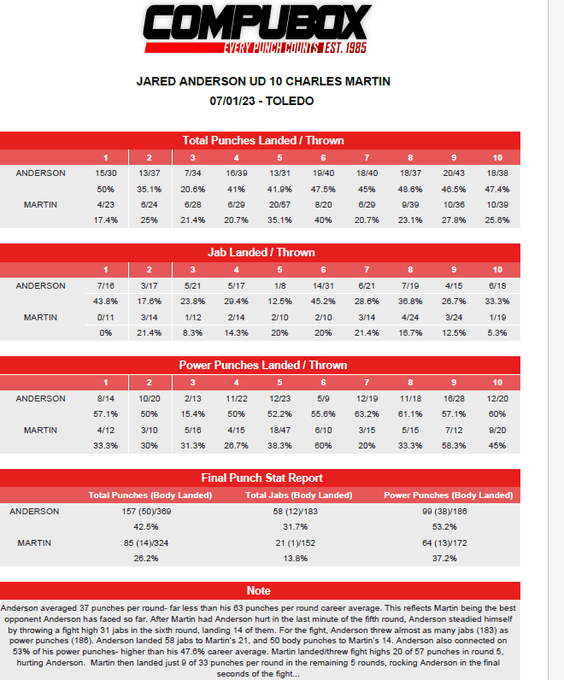
Jared Anderson faced his toughest test against former Heavyweight champion Charles Martin. 104 years ago, Jack Dempsey defeated Jess Willard in Toledo and now the undefeated Jared Anderson wanted to make his statement in the heavyweight division in Toledo, and he certainly won the fight on the scorecard. The decision was unanimous 99-90, 99-90 and 98-91 and I had it 99-90, but the reality was that Anderson showed heart and guts but also showed his inexperience.

Jared began using his quickness to gain control of the bout over the first quarter as he landed fifteen punches on Martin four punches. He won the first four rounds and looked like he was in control but in the fifth round, Anderson faced the challenge of his young career.  One weakness of Anderson nearly derailed his victory as he has a habit of moving straight back when avoiding punches and in the fifth round, Martin nailed him with a straight left halfway through the round. For the next ninety seconds, it was survival time as the inexperienced Anderson found himself trying to defend himself as Martin simply pounded him from one end of the ring to the other.

Survived he did and in round six, he came back out, connecting and out -landing by a two to one margin against Martin. The fifth round was the first round he lost in his career.

Anderson had never seen the seventh round in his young career, but he won all the remaining rounds as he out punched and out landed Martin the rest of the fight but in the tenth round, his inexperience nearly cost him the fight. With seconds left, he raised his hand in victory, knowing all he had to do was to survive those seconds, but Martin stunned him with a left and put Anderson on the defensive. He covered up as the final bell rang. He forgot that rounds last three minutes and not two minutes and forty-five seconds. The final Martin barrage was a little bit too little and too late.

Anderson normally averaged sixty-three punches per round with a 40 percent connect rate but tonight the average punches thrown was thirty-seven punches per round and he landed sixteen punches for an average of nearly 43 percent connect rate. Martin landed 85 of 324 punches for a mere 27 percent.

Anderson showed guts in surviving that fifth round and showed that he can take a punch of a legitimate puncher, but he also showed defensive lapses that nearly cost him the fight. Forget Martin’s punch stats, he nearly stopped Anderson in the fifth round and while Anderson nailed him numerous times with solid shots, Martin never appeared hurt, but he did manage to hurt Anderson in the fifth round and certainly stunned him in the closing seconds of the tenth round.  Martin did hit the canvas at the end of the third round but he got up quickly and appeared more stunned than hurt.

Anderson showed he can be a contender for the heavyweight title, but that time is not yet now.