If you want a free copy of https://posthillpress.com/book/the-rise-of-national-populism-and-democratic-socialism-what-our-response-should-be Direct message @Donelsonfiles on twitter.
Author: donelsonfiles
Lessons for 2020
There are many issues in which Not Trump voters agree with Trump voters in large enough numbers for the GOP to make the case that they are the party of change and opportunity and build a winning coalition. As the Democratic Party moves left, the GOP has a chance to entice enough Not Trump voters to join their coalition even with their personal dislike of Trump. On abortion, the majority of voters are pro-life and support restrictions on abortion, the only question is where to begin the restrictions. On trade, at least a third of Not Trump voters see the merit of Trump trade strategy. On economic growth, Trump and Not Trump voters view increasing debts, deficits or even spending as hurting the economic showing the rejection of Keynesian economics.
From 47% to 52%, voters overall approve of Trump handling of trade issues, immigration, economy and foreign affairs even if they don’t particularly care for him on a personal level. On Health care, most voters prefer choices in their health care, they want to keep their plans if they like them or keep their doctor and here the GOP can win if they chose to promote a health care plan that offers those things. The Democrat’s leading candidates will either be billionaires like Michael Bloomberg or Tom Steyer or they will go to younger more leftist candidates such as California Senator Kamala Harris, so likeability issue may not be factor as it wasn’t in 2016 when the Democrats nominated one of the most unlikeable candidates ever in Hillary Clinton. Ted Cruz survived a tough Senate race in 2018 despite being unlikable and outspent two to one, so being likable could be overlooked if the alternative is worse and the plan that Trump promoted in 2016 is working. For many Republican candidates, there is a discomfort with having Trump on top of the ticket.
Many GOP voters though like Trump more than their candidates for U.S. House and Senate so Republicans need to run on a positive message that they will be the party of reform and the Middle Class. Even with the recent gains by Democrats, the Democrat Party is still a Party of the two coasts and no longer the party of Middle America or the South. Much of Middle America and the South still remains Republican so the key issue for the GOP is whether they can get enough of the Democratic base to build a new coalition in key Midwest States just as Michigan or Wisconsin plus make inroads in Western states just as Colorado and Nevada. In Florida, school choice prompted 18% of black women to vote for Ron DeSantis and this alone would have propelled DeSantis to victory. In Tennessee, Martha Blackburn cleaned up in the suburbs, exceeded national average among blacks and Hispanics (gaining 45% of Hispanic voters in her state). In Missouri, Josh Hawley had similar success in both the Suburbs and with minorities plus turnout among black voters cratered for Claire McCaskill and Hawley did very similar among Hispanics than Blackburn. De Santis, Hawley and Blackburn received over 50% of suburban votes while on a national average the GOP only received 49%, the same as Democrats.
The lesson for GOP is to study these candidacies. Rick Scott did well among Hispanics and that even includes Puerto Rican voters and like De Santis, expanded his reach into the Suburbs. These candidates expanded upon the Trump coalition of 2016 and won as a result. The key for Republicans is to fight on issues and expanding the theme on fair opportunity to succeed. In 2020 and as long as the economy holds, the 2020 election will be a values election with values meaning more than just traditional social issues but more broad value battle including should voters chose their health care plan and their doctors or should the government do it for them? On the abortion issue, the battle will be on the value of when is life worth protecting or does the unborn allowed no rights to life? On economy, which values is more important, the right to a job and opportunity or do we engage in the politics of envy at the expense of opportunity. The GOP won’t have an easy time with Trump on the top of the ticket due to his personality but his ideas are more popular than his opponent’s will be and that is the battleground that needs to be fought, the battleground of ideas.
Some of best followers on the Donelson Files @donelsonfiles
Does Family Structure Matter and its political Impact
Click to access Family_and_Poverty_Election_Implications.pdf
Below is excerpts from this study done by the Foundation.
Thirty-five percent of Black families headed by single parents live in poverty compared to 7% of Black families and 38% of Hispanics single female head of house hold live in poverty compared to 12% of married Hispanic couples. Living in a single parent home increases the chances of children living in poverty and receiving government assistance, thus more likely to support big government programs and income transfers. But those programs have done nothing to help women and children rise out of poverty. Marriage is a significant factor in poverty and as Heritage Foundation Researcher Robert Rector noted, “Marriage remains America’s strongest anti-poverty weapon. As husbands disappear from the home, poverty, and welfare dependence will increase. Children and parents will suffer as result.” Family structure plays a factor in combating poverty and the evidence shows decline in family formation plays a role in the number of minorities in poverty.
In 1930, only 6.3% children were born out of wedlock but today that number has risen to 40%. 36% of single parents live in poverty compared to 6.3% of married couple. Only one out of four families with children are poor when contrasted to nearly 71% of families headed by single parents, showing that family formation is a significant factor in poverty. While many blame teen pregnancy for increase single parents, three out of five unwed children are born to women 20 -29.
Education plays a significant role in unwed mothers as the least educated women are more likely to have children out of wedlock. 67% of Women without high school degree have children without marriage whereas mothers with college degrees or higher have 8.3% chance of children out of wedlock. Education is a factor in whether a woman will have a child out of wedlock but regardless of education, married women are less likely to live in poverty. Only 15% of women who are married and without a high school diploma live in poverty whereas 47% of single female head of household dropouts live in poverty. 31% of Single female head of households with high school diploma live in poverty compared to only 5% of married families and 24% of single female head of households with some college degree live in poverty compared to only 3.2% married women live in poverty. Nearly 9% of women with college degrees or higher live in poverty compared to 1.5% of married families with college degree or higher.
From Larry Fedewa
Are fathers obsolete?
By Dr. Larry Fedewa (June 15, 2019)
After a generation of “free love”, unlimited abortions, increases in divorce, single mothers, unwed mothers, single sex parents, and fatherless children, it may be a good idea to re-visit the concept of fatherhood. For those who are unfamiliar with the term: a father is first of all a man, not a woman. A father is a man who is committed to his wife and who is willing to proclaim publicly and legally that commitment through a marriage ceremony. A father is a man who also has publicly and legally committed to support for any children who may be born of that union. Finally, a father is a man who has undertaken to maintain these commitments for life, through good times and hard times, “until death do us part.”
There is also another definition of “father”, which is taken in a biological sense, as the donor of the sperm which results in a birth, whether in or outside the marriage bond or any other level of commitment. Law and custom have attempted to enforce a commitment to various levels of support for the mothers and/or the children of such unions, but increasingly without success. After all, why bother when an abortion can eliminate the claim, and the refusal to abort can be interpreted as a relinquishment of all such claims? In our current world, therefore, “biological father” is almost useless as a definition of “father”.
That leaves the traditional meaning of the term as described above. It also leaves that definition as increasingly rare in our experience, or so the movies and news would have it. The popular culture has elevated the roles and rights of women at the expense of men in general, and fathers in particular. But what difference does it make?
Who needs fathers?
Before we answer that question, it is instructive to think about why such a question should arise in the first place? The answer has to do with the “sexual revolution” of the 1960’s. That is when oral contraceptives came into common use in the Western world. This development coincided with the recognition that children were no longer the economic bonus in urban America as they had been in rural America. A large farm family had a financial advantage as the children grew up because of lower labor costs. A large family of city-dwellers has higher costs of housing, food, health care, and education with no corresponding increase in income. The ability to limit pregnancies easily was thus a simple, straightforward answer to this dilemma.
But along with these family planning conveniences came another result: the increased opportunities for promiscuity. Until the introduction of oral contraceptives, the customary and intuitive role of women had been as guardians against out-of-wedlock liaisons. Suddenly all restrictions became unnecessary if the female contraceptives were employed. Sexual activities came to be viewed as a form of entertainment. Adverse results in the form of pregnancies were easily prevented by prescriptions or eliminated by legal abortions.
In this more promiscuous environment, other social movements caught fire. Women began to realize that their social roles were no longer restricted for the family-rearing years by unwanted pregnancies. Women’s rights to independence and careers outside the home had accelerated during WWII when women began during jobs previously reserved for men (remember “Rosie the Riveter”). These trends took on a new life and evolved into a major economic factor as an extension of the available workforce.
Another consequence was a massive re-thinking of the role of men in society. The first responses in many cases were nearly grotesque, men taking every advantage of the sudden lifting of female safeguards against illicit sex. Divorce rates soared, marriage rates began to decline, as did pregnancies and birth rates.
As the sexual revolution matured, women demanded an expanded role for men in marriage, e.g. sharing housekeeping and baby care, as well as less control over family matters (since they were often major financial contributors). There were no rules. Traditional rules didn’t really apply and there was little consensus regarding new rules. In the meantime, women re-discovered the joys of motherhood, but increasingly without fathers present.
Who needs fathers? Not today’s modern women, say the feminists.
What are the results of this change in the winds of family life? For one thing, a lot of fatherless children. And a lot of over-stressed and overworked women. And a lot of lonely and distressed men. This new system doesn’t seem to be working.
One place to start rebuilding a healthy family life would be with men. Perpetual adolescence may be fun and exciting, but it is no way to live your whole life. Men need children as much as women do. Men need to have someone to care for, to live for, and, if necessary, to die for. Fathers are not like the bachelor stallions who live on the periphery of the herd waiting for the chance to mate with a wayward mare. We all need our own little band, our family. If circumstances – physical or otherwise – make fathering our own family impossible, some substitute should be found. Whatever its form, that fathering nevertheless has its own requirements.
A father must be a good husband – that means willing to support his wife emotionally as well as financially – to the best of his ability, as long as they both shall live. Some men duck out of marriage at the worst possible times, the times of greatest loss, whether sickness, finances or even death. No family can build a successful life on such a shaky foundation.
A father must be a good father – patient with his children, willing to sacrifice for them, to love them, and to help them face their own lives as they encounter each test along the way.
Who needs a father?Your son needs a father to show him how to live, how to love, how to have fun, and how to die. Your daughter needs to know that there are good men in the world. Men make up half the world’s population. Your daughter needs to know how to tell the good ones from the bad ones. All her life she will compare the men she knows with the father who raised her.
You are that father. She needs you.
Photos: Summer approaches





From Larry Fedewa “Dr. Larry”
Capitalism and Judeo-Christian Values
By Dr. Larry Fedewa (June 9, 2019)I cannot leave the topic of the wealth gap in today’s America without commenting on the most fundamental factor in the origin and the evolution of Western capitalism. That factor is the existence of Judeo-Christian values.
It is not an accident that capitalism originated and owes its development as well as its endurance through the past millennium in a civilization dominated for much of that time by the Judeo-Christian religion.
The most unique and the most fundamental standard of that ethic is the equality of all human beings in the sight of God. Thus we all have equal rights to salvation, to justice and to the fruits of the earth.
Capitalism is founded on this principle of equality. Without it there would be no reason for an economic system which provides a means of distributing the goods of the earth to as many people as earn possession.
The foundation of capitalism is the concept of private property. As an economic system, capitalism provides the conditions for acquiring and keeping private property. These conditions are expressed in money, the language of capitalism, and they are protected by a legal system which is intended to treat all with respect. The use of money instead of goods or services, as in a system of bartering, has made practical the accumulation of value, which is called “capital” from which the name of the system is derived.
While capitalism has made possible the reduction of human poverty, the viability of democratic institutions and upward mobility, it is not without its limitations and potential evil. Its greatest threat is greed. Greed has led to monumental evils in the history of capitalism, including slavery, mercantilism, and social evils such as child labor and all manner of criminal behavior.
Through ever vigilant counter-forces, however, such as religion, organized labor and government regulation, capitalism has evolved into a more benevolent system in the advanced versions of Western civilization.
The capitalist system, however, must continue to evolve in order to integrate new developments in technology and the social consequences of these innovations. One of the most significant of these consequences is the gap between the very rich and the middle class which has been developing for the past generation and has become critical since the “Great Recession” of 2007-8.
This disparity has been noticed and denounced by the American Left and many in the mainstream of American life. There have been warnings by various sources of violence and even revolution. While these predictions may be extreme, the fact remains that the control of up to 80% of America’s wealth by 1% of the population is an affront to the America’s sense of fairness, not to mention a dangerous threat to the future of America’s consumer economy.
It is also a sin against God’s people. The sin is not so much that of individuals who are proceeding according to the accepted practices of the current system. The evil is in the distortion of social justice which has occurred more or less undetected through the recent past.
What happened was the explosion of digital technologies and their impact on productivity. The vast increases in productivity over the past generation have caused increases in wealth unimagined by earlier generations. Under the old customs, the distribution of that new wealth went to the inventors and the investors of the new technologies, and the workers who actually produced the products and services were left behind. No one entered the arena to question this arrangements to fight for the rights of the workers. The effect is the creation of two worlds, two societies, one consisting of the very wealthy and the other of everyone else.
This development threatens a reversion to the 18th century, before the French Revolution, when feudalism reigned in the Western world. This situation must be rectified by a redistribution of wealth. There are only three alternatives: 1) maintain the traditional “trickle-down” theory of capitalism – which has never worked in human history; 2) empower the government to confiscate the wealth of the 1% through taxes and then to re-distribute that wealth through welfare programs; or 3) through a reformed capitalism which recognizes the right of workers to share in the profits (or losses) of their companies. That such a capitalism can exist is proven by the “Conscious Capitalist” and similar movements.
Like most Americans, I believe in the dignity of work. I also believe in the cooperative business model practiced by the 1600 Conscious Capitalist member businesses with their 3 million employees. I also believe in the superior morality of this approach to business.
As I wrote last week:”Why are the workers not entitled to a greater share of the gains which these increases in productivity have brought to life in the public square? After all, without them, these innovations would still be unknown, condemned to eternal obscurity. By what right do the owners (investors) get to determine that they are entitled to 80% of the firm’s assets while the workers – whose role is also critically important to the success or failure of the enterprise – collectively receive 20% or less?
“These are human beings, not robots, not slaves, not units to be discarded or exploited. The old “survival of the fittest” logic does not belong, is not expected, and is not to be tolerated in today’s capitalism. Each company, each organization, each business is based on a culture akin more to a family or a tribe than to a 20th century factory. After all, we spend more time at work than at home, at play, or in social activities. More of our lives with our fellow workers than with our families.
“Success in the business world of this new century demands the pride of accomplishment, respect for the dignity of work, and a company culture which strives to promote the human goals of joy and even love of one’s fellows. These are the coming, growing companies, the ones which will survive and thrive in the dawning of the new day.”
A reformed capitalism can revive the prosperity of the middle class, tackle the geo-physical problems of our time, expand the shadow of progress to the underdeveloped lands , and lead this generation to new heights of world prosperity. But the light of the new capitalism must not be extinguished by misguided government controls which dampen the spirit and crush the mind. For America must continue as the light of the world to conquer the darkness of poverty and totalitarianism, or the world will face another Dark Age.
From Institute Of Energy Research
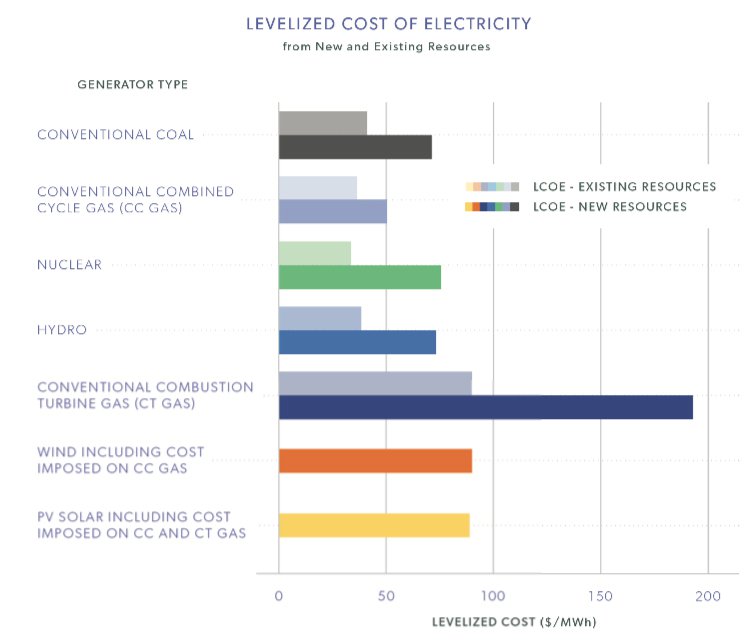
Tom Pyle, President of the Institute for Energy Research stated:
“This study illustrates why foolish policies like the Green New Deal and 100% renewable mandates would harm our economy and significantly raise the cost of electricity for American households. Shifting our electricity generation away from existing affordable and reliable plants to expensive and intermittent wind and solar would substantially increase energy costs for businesses and families. This study provides a necessary reality check for anyone making decisions about America’s electricity policy.”
Michelle Bloodworth, President and Chief Executive Officer of the American Coalition for Clean Coal Energy (ACCCE) said:
“This new study is unique because it provides an apples-to-apples comparison of existing and new electricity sources. The study shows that policymakers should carefully consider levelized costs when decisions are being made to retire coal-fired power plants because replacing them with gas, wind or solar could be a bad economic decision.”
Links worth reading from the Hill: Russian Collusion
From CEI Worth reading
From CEI
Bjorn Lomborg and John Christy Shred Climate Alarmism
Marlo Lewis, Jr. • June 6, 2019
The latest talking point of progressive politicians, pundits, and activists is that America cannot afford not to spend trillions of dollars to “solve the climate crisis” because global warming is an existential threat. As Sen. Bernie Sanders (I-VT) put it, “You cannot go too far on the issue of climate change. The future of the planet is at stake, OK?”
Abysmal Benefit-Cost Ratio
That is sham wisdom even if climate change were the terror Sen. Sanders imagines it to be. The resources available to public and private decision makers are finite. Resources allocated to “climate action” are no longer available to make mortgage payments, pay college tuitions, grow food, fund medical innovation, or build battleships. Prudent policymakers therefore not only consider the costs of policy proposals but also compare the different benefit-cost ratios of competing expenditures. As it happens, the benefit-cost ratios of carbon suppression policies are abysmal.
For example, just the direct expense of the electric sector portion of the Green New Deal would, conservatively estimated, cost $490.5 billion per year, or $3,845 per year per household, according to American Enterprise Institute economist Benjamin Zycher. Yet even complete elimination of U.S. greenhouse gas emissions would avert only 0.083°C to 0.173°C of global warming 70 years from now—a policy impact too small to discernibly affect weather patterns, crop yields, polar bear populations, or any other environmental condition people care about.
The climate “benefit” over the next 10 years would be even more miniscule. Yet during that period, Zycher estimates, the annual economic cost of the GND electric sector program would be about $9 trillion. It is unwise to spend so much to achieve so little.
No Planetary Emergency
The doomsday interpretation of climate change is a political doctrine, not a scientific finding, as Danish economist Bjorn Lomborg shows in a recent series of tweets and University of Alabama in Huntsville atmospheric scientist John Christyexplains in a new paper titled “Falsifying Climate Alarm.”
In the aforementioned tweets, Lomborg rebuts an op-ed by Nobel economist Joseph Stigletz, who advocates spending trillions of dollars annually to combat climate change, which he calls “our World War III.” As evidence, Stigletz claims that in recent years weather-related damages cost the U.S. economy 2 percent of GDP—a figure for which he gives no reference.
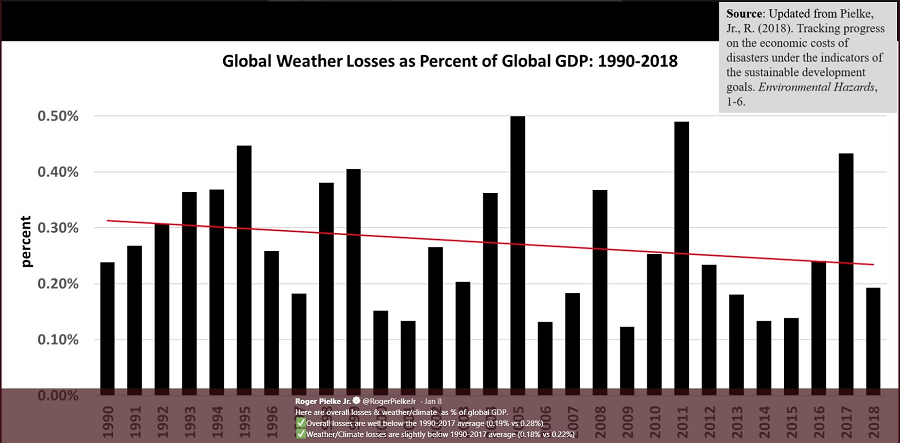
Lomborg deftly sets the record straight. Aon Benfield reinsurers estimate that during 2000-2017, weather-related damages cost the United States about $88 billion annually, or 0.48 percent of GDP per year, not 2 percent. More importantly, extreme weather is a natural feature of the Earth’s climate system. The vast majority of those damages would have occurred with or without climate change. “Does Stiglitz believe there is no bad weather without climate change?” Lomborg asks.

In the United States, hurricanes are the biggest cause of weather-related damages. Hurricanes have become more costly over the past 120 years but not because of any long-term change in the weather. Once historic losses are adjusted for increases in population, wealth, and the consumer price index, U.S. hurricane-related damages show no trend since 1900.

The past three decades are generally agreed to be the warmest in the instrumental record. Yet during that period, damages due to all forms of extreme weather as a share of global GDP declined. In other words, despite there being many more people and lots more stuff in harm’s way, the relative economic impact of extreme weather is decreasing. It is difficult to reconcile that trend with claims that ours is an “unsustainable” civilization.
Lomborg provides an even more telling rebuttal point in a previous Tweet. Since the 1920s, atmospheric carbon dioxide (CO2) concentrations increased from about 305 parts per million to more than 400 ppm, and global average temperatures increased by about 1°C. Yet globally, the individual risk of dying from weather-related disasters declined by 99 percent.

Stigletz claims we cannot afford not to spend trillions to mitigate climate change because “our lives and our civilization as we know it is at stake, just as they were in World War II.” Lomborg notes that in the peer-reviewed literature, unchecked climate change is estimated to cost 2-4 percent of global GDP in 2100. That “is not the end of the world,” especially considering that, despite climate change, global per capital incomes in 2100 are expected to be 5-10 times larger than today.
Ironically, in the “socio-economic pathways” (SSPs) literature, the richest SSP is the one that relies most on free markets and fossil fuels.

Source: Keywan Rhiahi et al. 2017. “This world [SSP5] places increasing faith in competitive markets, innovation and participatory societies to produce rapid technological progress and development of human capital as the path to sustainable development. . . . At the same time, the push for economic and social development is coupled with the exploitation of abundant fossil fuel resources and the adoption of resource and energy intensive lifestyles around the world.”
John Christy’s new paper, published by the Global Warming Policy Foundation, summarizes two of his recent peer-reviewed studies. In 2017, Christy and fellow atmospheric scientist Richard McKnider examined 37.5 years of satellite data in the global troposphere (bulk atmosphere). Christy and McNider factored out the warming effects of El Ninõ and the cooling effects volcanic aerosol emissions. The underlying greenhouse warming trend—the dark line (e) in the figure below—is 0.095°C per decade, or about one-fourth the rate forecast by former NASA scientist James Hansen, whose congressional testimony launched the global warming movement in 1988.

Christy and McNider estimate that when atmospheric carbon dioxide concentrations double, global warming will reach 1.1°C—a quantity called “transient climate response.” Christy comments:
This is not a very alarming number. If we perform the same calculation on the climate models, you get a figure of 2.31°C, which is significantly different. The models’ response to carbon dioxide is twice what we see in the real world. So the evidence indicates the consensus range for climate sensitivity is incorrect.
In 2018, Christy and economist Ross McKitrick set out to test the accuracy of climate models. They examined model projections in the atmosphere between 30,000 and 40,000 feet, in the tropics from 20°N to 20°S. The atmosphere warms fastest in that portion of the atmosphere in almost all models used by the U.N. Intergovernmental Panel on Climate Change (IPCC), such as the Canadian Climate Centre model, shown below.

In 102 model runs, the average warming in the “hot spot” portion of the tropical atmosphere is 0.44°C per decade, or 2°C during 1979-2017. “However, the real-world warming is much lower; around one third of the model average,” Christy reports.

Christy sums up the test results:
You can also easily see the difference in warming rates: the models are warming too fast. The exception is the Russian model, which has much lower sensitivity to carbon dioxide, and therefore gives projections for the end of the century that are far from alarming. The rest of them are already falsified, and their predictions for 2100 can’t be trusted. If an engineer built an airplane and said it could fly 600 miles and the thing ran out of fuel at 200 and crashed, he wouldn’t say ‘Hey, I was only off by a factor of three’. We don’t do that in engineering and real science. A factor of three is huge in the energy balance system. Yet that’s what we see in the climate models.
Statements like the following are increasingly common in popular media, academic journals, and political discourse: “The evidence that anthropogenic climate change is an existential threat to our way of life is incontrovertible.” Not so—not even close.
 The Donelson Files