| infected | tested | |
| US | 404,056 | 2,107,442 |
| Italy | 135,586 | 755,445 |
| UK | 55,242 | 266,694 |
| S Korea | 10,384 | 477,304 |
| Germany | 109,329 | 918,464 |
| France | 109,069 | 224,254 |
| Spain | 146,690 | 355,000 |
| Switzerland | 22,789 | 171,938 |
| Belgium | 23,403 | 84,248 |
| Netherlands | 20,249 | 86,589 |
| Canada | 18,487 | 348,105 |
| Sweden | 8,419 | 54,700 |
| Australia | 6,013 | 319,368 |
| Norway | 6,086 | 113,896 |
| Denmark | 5,386 | 58,419 |
| Israel | 9,404 | 117,389 |
| Portugal | 13,141 | 128,874 |
| total | 1,103,733 | 6,588,129 |
Category: Politics and Issues
thoughts
A reporter passed this story about friend whose father passed away from the virus. His friend noted that his father died with a stranger hand holding him as his wife was home, isolated and scared. The late singer John Prine who passed away from COVID, in his song Hello in There, reflects these thoughts that many of our elderly are going through.
“Ya’ know that old trees just grow stronger
And old rivers grow wilder ev’ry day
Old people just grow lonesome
Waiting for someone to say, “Hello in there, hello”
What scares Americans more is not just the virus but the fear of the unknown and what will happen next. Will a love one be stricken, when can our lives return to normal if ever? Our countries have survived many crises, the American Civil War, the Great Depression, World War II in which we defeated Nazism and fascism and we stood tall against Soviet Empire in the Cold War and the Spanish Flu of 1918-20.
FDR stated that all we have to fear was fear itself. In 1980, America was suffering double digit inflation, the Soviet Empire was on the march and many Americans feared our best days were behind. An associate once ask how I could be optimistic and my answer, “I have two children and I am optimistic because I have no choice for them.” Today I am equally optimistic that we will triumph. While we barely see a light at the end of the tunnel, but in the midst of this, we have people who are already to planning trips to Mars. The future is bright if we allow the future to unfold and be not afraid.
For many Christians, this is Holy Week which includes not just the crucifixion of Jesus Christ but his resurrection. Hope prevails on Easter Sunday and it will prevail again. We have nothing to fear but fear itself and nor is this the time to allow fear to run our lives but be optimistic that this will pass. And if we follow the right example of history, we will see a new and brighter future.
From Dr. Larry
| Dr. Larry talks opening of the economy |
| How do we end this? |
| Employers must be part of the re-open strategy |
 by Dr. Larry Fedewa (Washington DC –April 6, 2020) Two weeks ago, we discussed “Trump’s huge gamble”, namely, his decision to follow the action plan prescribed by the public health experts rather than attempt to mitigate the effects of coronavirus with less drastic means. To date, that strategy seems to be effective in reducing the spread of the disease to more or less manageable dimensions. The prevalence of cases seems increasingly limited to densely populated urban areas, most notably, New York City. The economic cost, however, is already beyond any recession in recent memory, with the possibility of becoming catastrophic. The entire sequence of events is unique in American history. Never before has the country simply stopped in place 75% of the economy. The closest parallel may be the 14th century Black Death which is estimated to have reduced the population of Europe by 50% after returning several times over a span of two generations. But the resulting drastic effects on the medieval economy were not voluntary like this one. Plus, it was so long ago that few lessons can be drawn to benefit our current decisions. It is clear that America’s economic activity is in great jeopardy if our workforce is kept from their jobs for too long. It is also clear that the virus is not yet under control. Because there was no preparation on the part of FEMA (Federal Emergence Management Administration) or the 50 state Directors of Emergency Management, there have been perilous shortages of medical protection gear, available staff, and pharmaceuticals. By truly amazing agility, imagination and herculean effort, the Administration has been able to enlist private companies to lend their efforts to supplying these deficiencies. Along with military resources, in terms of staff, expertise, and facilities, the nation is slowly — with increasing speed – providing all the resources required. One of the most glaring discoveries was the utter dependence of America on supply chains which were dominated by foreign countries, including China and Europe. A likely outcome of this experience will be the rebuilding of America’s manufacturing capabilities of critical products, bringing the supply chains home. Now the race is whether the pandemic will subside soon enough to allow work to resume. In the practical sense, the ultimate success of the entire episode will depend on whether the decision to reopen the economy turns out to be the correct one or not. As I pointed out earlier, the stakes could not be higher. If we start to work too early and the death rate climbs, we either have to stop again or watch this highly contagious disease spread like the California wildfires. If we wait too long, the economy may not be able to recover in time to save us from a recession or, even worse, a depression. In either case, people will suffer, through death or destitution. And the re-election of the President will be problematic at best. There is no way to predict with any certainty when to re-open the economy. So, it seems that the time is here for us to develop a re-open strategy. Several ideas are beginning to float around. The first option appears to be whether to re-open all at once or gradually. If we re-open every business and crowd event at once, there must be provision made for the victims still under care as well as for the possible recurrence of the pandemic. It would seem that universal testing would quickly become a requirement for resumed activity of every individual in the country. However, right now there are not enough test kits available to accommodate a population of 330 million people. Nor is there enough excess staff capacity to administer even a small percentage of that population. Which leads to the need for a self-testing product. Which doesn’t exist. And which would presumably require laboratory processing – and there is not enough such capacity in the entire USA to accomplish such a herculean task. On the brighter side, the President and Dr. Deborah Birx in their April 6 news conference alluded to a whole new generation of therapeutic products, including work on a fingerprint test for COVID-19. Such a test could be used for mass testing – but it is not yet available. This line of reasoning would suggest that the only reasonable alternative would be some sort of gradual re-opening of the stores, factories, delivery systems, and services that comprise the American economy. On what basis then does a “gradual” re-opening take place? “Critical” versus “uncritical” criteria are very difficult because of inter-relatedness of so much of our commerce. “Critical” is a slippery slope. “Safe” is also an irrelevant criterion under these circumstances. By geography? Geographical distinctions per se provide a delicate foundation for many of the same reasons. What then? The answer is not an easy one due to the need to include so many factors, including the unknown availability of new therapies which are targeted to alleviate coronavirus symptoms. There is also the fact that Americans are a free people. Ultimately, employers and workers are each free to do as their own judgement dictates, no matter what the governments may authorize. A few steps, however, do seem obvious. The first attention should be addressed to the people and industries that are already working. A loosening of regulated behavior might start with measures to enhance existing practices with a view to making some of them permanent. For example, many restaurants have ventured into delivery and pick-up services for their food. One step might be to invest in beefing up those facilities with additional personnel and equipment (cars, trucks, computers). Likewise, there is a lot of work being performed at home. In some cases, flexible schedules may actually improve productivity. Another step might be to increase investments to support the expansion of supply-chain companies in the homeland. Attention might also be given to protective gear for ordinary workers, using the model of health care workers but abbreviated to fit other workplaces. For example, steel workers and miners already wear head gear which might be extended to protect against airborne diseases. These ideas are still applicable only to the periphery of the America’s workplaces. However, they do emphasize the critical requirement that all employers – government and private – be brought into the planning process in order to develop a re-open/recovery strategy that is suited to the present circumstances. Whether that plan is gradual, local, and/or national, it is imperative to bring the business community perspective into whatever planning is occurring to balance the public health perspective which has been calling the shots so far. Such plans must, of course, be effective at both protecting the American people – from infants to schoolchildren to workers to the elderly – from this plague while resuming the vigorous economy we had before COVID-19. And we will have it again, as we recover from our latest crisis. And we will recover!! |
A few more thoughts.
Lancet did a study to get a clearer picture of the mortality rates. Lancet view the rate when one includes mild cases (many of whom who don’t get tested and are not included in the stats), as .66, less than 1% but at least five to six times more lethal than flu but less than the Spanish Flu. Or is it because our medical care is better?
The problem we have is that we are working with incomplete data and we can make the following assumption. One, the number of infections is higher than the numbers reported because we are not testing everyone. There have been articles in which different standards used to report death to the COVID virus, so we may not have a complete accuracy of the numbers of the death. Lancet data will show percentage of mortality is lower but also may be five to six times more lethal than the flu, but it is not SARS or even Spanish flu. We have to include that in our economic decision. As someone who has polled hundred of thousands, I view much of the data collection the equal of polling a state but polling only 60 percent of the state. A candidate pollster who did this would be providing his or her candidate an incomplete picture and this could cost an election.
Models are as much art as science and depends upon the data put in. If the data is inaccurate or incomplete, the model will present bad information. The Modelers also have to guess how human would react to initiatives. The University of Washington have made mistakes in guessing mortalities, number of beds required and overall data dealing with the infection. One model in Great Britain was off be a factor of 10-fold when redone a couple of weeks later but British government-based policies on the original data. Experts consulting to 538.com website. has changed in the past two weeks their own estimates from 200,000 Americans dying to 263,000 deaths. If nothing else, this has shown that to depend upon Models for policy is risky and if you can’t predict accurately a week or even a day out, how could you depend upon modelers for longer term. This should give any politician using models to predict future climate pause in depending upon the on policy.
The drug combination Hydroxychlorine/Azithromycin is proving to be effective in selected patients but there are very little controlled studies to prove its worth, but thousands have been treated and thousands of doctors have sworn by its use. This drug is not innocuous and does have side effects so it is a panacea for the virus but it is a first step in helping patients. In normal times, double-blind studies are essential to finding a drug efficacy, but in this case, we are looking at life and death and economic shutdown. The FDA has to adjust its rule to the situation.
Speaking of bureaucracy, they have been a big failure as they have delayed diagnostic tests and production of masks and these delays has hurt our response. The bureaucrats are not protecting Americans by possibly killing them by these delays.
When this is over, our policy toward China needs to re-examine as they have lied and are still lying about this virus. They suppressed information and delayed response to this pandemic and allowed the virus to escape. There is evidence that this virus escaped from a Chinese laboratory as oppose the wet market and British government believes that Chinese government may be underestimating the total number of infected and death by a factor of 15 to 40 times. That means we are talking anywhere between 1 million to 3 million Chinese infected and from 50 to 150,000 dead Chinese. We are talking worldwide infected two to three times what we are seeing and worldwide death as many as 225,000 dead.
India decided not to export Hydroxychlorine to keep for their own people but in a future world in which there could be a decoupling trade from China, India stands to gain but if the rest of the world doubt their reliability as a trading partner, India won’t benefit. After a conversation with President Trump, India decided to allow some of the drug to export. Maybe Trump reminded India of a future role in a post COVID era.
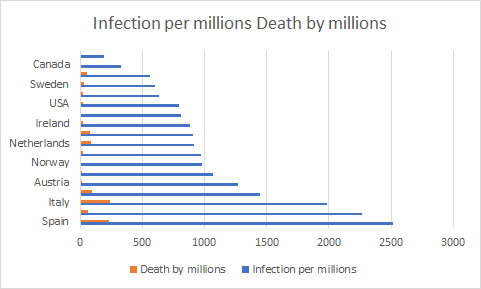
Chart infections by Millions
| Infection per millions | |
| Spain | 2888 |
| Switzerland | 2502 |
| Italy | 2192 |
| Belgium | 1796 |
| Austria | 1363 |
| Germany | 1209 |
| Norway | 1063 |
| Portugal | 1150 |
| Netherlands | 1097 |
| France | 1502 |
| Ireland | 1086 |
| Israel | 995 |
| USA | 1076 |
| Denmark | 808 |
| Sweden | 714 |
| UK | 760 |
| Canada | 426 |
| South Korea | 201 |
| Australia | 227 |
Data for the Day Death by millions April 6th
| Spain | 282 |
| Switzerland | 88 |
| Italy | 273 |
| Belgium | 141 |
| Austria | 24 |
| Germany | 19 |
| Norway | 14 |
| Portugal | 31 |
| Netherlands | 109 |
| France | 137 |
| Ireland | 35 |
| Israel | 6 |
| USA | 32 |
| Denmark | 32 |
| Sweden | 47 |
| UK | 79 |
| Canada | 9 |
| South Korea | 4 |
| Australia | 2 |
Models and the Virus
The world of Modeling has taken a blow, as the numbers of both those infected and those that will die have run the gamut from below 100,000 to 2 million. 538 recent survey that experts have changed their outlook from 200,000 to 263,000 as the new consensus with 1,500,000 on higher end. A British survey went from 500,000 dead to 20,000, a change of factor of 25. Much of the guesswork is based on human activity and how Americans will follow the recommendation and also on the virus itself.
Problem with modeling is that we are basing government policies and we are still finding out about the virus itself and the data is incomplete. The mortality rate is instructive but inaccurate since it doesn’t include many mild cases and are not random but strictly those who are seeing physicians. Since many are told to stay home unless symptoms show up. The infection numbers are underestimating actual infection and overestimating the death mortality rate.
Alex Berenson on his twitter site has been following Mhme_WA and notice how often they have overestimated numbers of infection, hospitalization and noted, “States and WH need to provide clarity for the end of the lockdowns. Where there be one standard? Will states be allowed to go on their own? Will the metric be hospitalizations, new cases, decline in either/both, something else?”
One modeler noted,” I decided to publish and speak out because the response to this pandemic is having a huge effect on the lives of vulnerable people with a profound cost and it seems irresponsible that we should proceed without considering alternative models. Imperial has a long history of involvement with government and its epidemiological models can have huge importance and translational impact but it’s tricky to use them to forecast what’s going to happen. We need to also consider alternatives.”
If nothing else, we need to review the Models and decide to what extent they were right and they were wrong. And maybe we might want to review the model that is becoming the basis for many in determining our energy policy and Climate change. If we are seeing questionable assumptions the basis of these policies dealing with COVID-19, then maybe we might review other models, like those dealing with Climate science.
Economics In COVID Era
Finished John Barry book on The Great Influenza and James Grant book on The Forgotten Depression, we might get an idea of what we can expect over the next two years. Barry book details the human cost of the pandemic and science but little on the economic details while Grant discusses the economics but little of the connection between the virus and the overall economy.
We have a recent study from Federal Reserves discussing the impact of the 1919 Pandemics and concluded that Pandemics do impact the economy negatively and Non-Pharmacological interventions including social distancing do not. They made the case that those communities who practiced NPI saw quicker economic recovery. Cole and Ohanian detailed in their studies how the Hoover Administration and the early years of FDR allowed government interventionist policies to start the Great Depression and delayed full recovery. The lessons from Cole and Ohanian is that bad government polices can retard and delay a full recovery. As soon as the crisis passes, government policies can either bring a quick recovery or delay any recovery, if not kill it.
According to a recent Lancet Study, the overall mortality rate could be .66 which is considerably less than the 3% mortality rate often calculated, but regardless, even at .66, it is six times as lethal as the flu but less than the Spanish flu which killed nearly 700,000 Americans in a country that was one third the population today.
As the virus began, World War I was coming to an end and the United States economy was a war command economy but as Wilson administration was coming to an end, Woodrow Wilson was incapacitated by a stroke, There were many similarities between now and Spanish Flu epidemics. There were in place many government controls from the wartime economy in 1918 thru 1920. Wilson Administration ran the entire economy through boards, and we are witnessing a similar pattern as government edicts has closed down the entire economy as Government at all levels has shut down the economy in an effort to flatten the Pandemic.
Federal Reserve inflated the currency during the World War I and this continued after the War. Grant noted the economy continued to grow in 1919 before crashing in 2020. Barry detailed how the epidemic empty many streets, leaving the impression that in 1919 and going into 1920, the economy was in a tailspin. Federal reserve study found that manufacturing output dropped 18%.
What are the lessons for us? As already mention, the government is controlling every aspect of the economy, pushing companies to build masks and ventilators while many state and local governments are allowing what they consider essential business to stay open and closing others. Brian Westbury stated that if we begin open up first of the May, we can save 92% of the economy but added many small businesses are already out of business and the longer we wait, the more damage to the economy. By the time June ends, we may be only able to rescue 85% of the economy. Many small businesses will close their door for good.
The Federal reserve has already open the printing press, and Congress stimulus includes direct payments to Americans along with more money added to unemployment so you combine government running economy along with this stimulus, you may find a similar path following along what America did 1919 and 1920.
In 1920, Democrat administration was paralyzed with an ill President and a Vice President who noted that what America needed is a good five cent cigar, so the Recession continued into 1921. Harding allowed the economy to heal on its own, cutting taxes and the budget while raising tariffs. The economy roared back.
The economic opening will be partial and not enough to engineer a full recovery and the rest of the world is in decline. As long as travel ban stays in the place, there will be no trade as well. The World economy is in total decline. The key is to reduce the death total and begin the process of reigniting the economy. Some economist sees a big rebound in 2021. How do we get there?
With no vaccines on the immediate future and the infection spreading toward hopefully to a plateau, the reopening will need to start earlier as oppose later. Among things we can do starting in May in most of America:
- A partial opening would include restricting people in businesses. If a restaurant has a capacity for 100, you allow 50, with customer using every other table. If people wear masks, and maintain social distancing from each other at work, we can reduce transmission.
- Elderly and immunocompromised can be isolated.
- We have drug therapies that can help get many people to recover quicker.
- We can have expanded testing to include places like Wal-Mart and businesses since testing may gives us results in as little as five minutes.
While Congress is talking another stimulus, we have enough stimulus in the economy and what we need is people to begin working. We need to create opportunity and set the stage for the economy rise. That means we need to be starting on proposing those things to grow the economy beginning getting budget under control once this crisis passes, getting our monetary policy square and continue an aggressive deregulation along tax reforms to increase economic growth. Americas Majority Foundation has worked on these issues including building an investor class, helping business formation and a tax plan designed to help both the Middle Class and increase economic growth while saving the entitlements.
And as soon as we can lift the various controls that many state and local governments, we can begin growing the economy. A Vaccine will likely be ready in 2021 and that will help along with the right economy policy, will set the stage for a full-scale recovery.
Biden solution
Biden campaign has now conceded that Trump’s travel ban was the right thing to do, so that means everything Biden has supported, Trump has already done. Biden has conceded that Trump’s plan to deal with the virus is correct and Biden would not have done anything different. Nor anyone else for that matter.
Charts
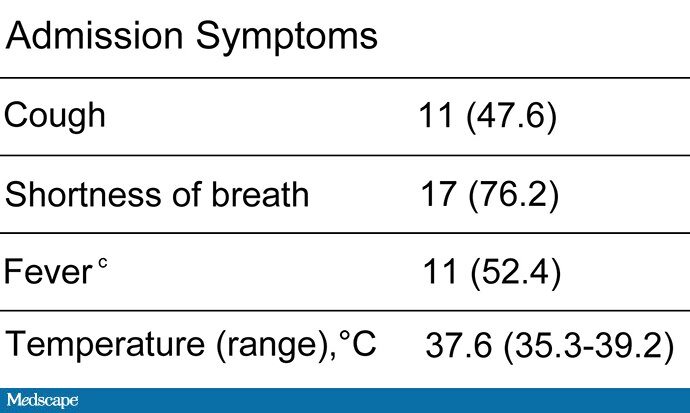
Below is reason for admissions.
 The Donelson Files