Category: Politics and Issues
From Institute Of Energy Research
Tom Pyle, President of the Institute for Energy Research stated:
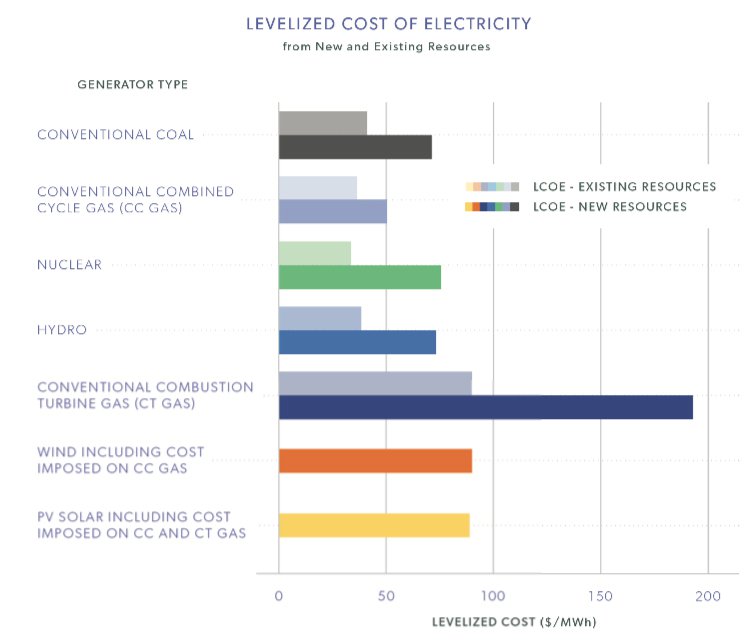
“This study illustrates why foolish policies like the Green New Deal and 100% renewable mandates would harm our economy and significantly raise the cost of electricity for American households. Shifting our electricity generation away from existing affordable and reliable plants to expensive and intermittent wind and solar would substantially increase energy costs for businesses and families. This study provides a necessary reality check for anyone making decisions about America’s electricity policy.”
Michelle Bloodworth, President and Chief Executive Officer of the American Coalition for Clean Coal Energy (ACCCE) said:
“This new study is unique because it provides an apples-to-apples comparison of existing and new electricity sources. The study shows that policymakers should carefully consider levelized costs when decisions are being made to retire coal-fired power plants because replacing them with gas, wind or solar could be a bad economic decision.”
Links worth reading from the Hill: Russian Collusion
From CEI Worth reading
From CEI
Bjorn Lomborg and John Christy Shred Climate Alarmism
Marlo Lewis, Jr. • June 6, 2019
The latest talking point of progressive politicians, pundits, and activists is that America cannot afford not to spend trillions of dollars to “solve the climate crisis” because global warming is an existential threat. As Sen. Bernie Sanders (I-VT) put it, “You cannot go too far on the issue of climate change. The future of the planet is at stake, OK?”
Abysmal Benefit-Cost Ratio
That is sham wisdom even if climate change were the terror Sen. Sanders imagines it to be. The resources available to public and private decision makers are finite. Resources allocated to “climate action” are no longer available to make mortgage payments, pay college tuitions, grow food, fund medical innovation, or build battleships. Prudent policymakers therefore not only consider the costs of policy proposals but also compare the different benefit-cost ratios of competing expenditures. As it happens, the benefit-cost ratios of carbon suppression policies are abysmal.
For example, just the direct expense of the electric sector portion of the Green New Deal would, conservatively estimated, cost $490.5 billion per year, or $3,845 per year per household, according to American Enterprise Institute economist Benjamin Zycher. Yet even complete elimination of U.S. greenhouse gas emissions would avert only 0.083°C to 0.173°C of global warming 70 years from now—a policy impact too small to discernibly affect weather patterns, crop yields, polar bear populations, or any other environmental condition people care about.
The climate “benefit” over the next 10 years would be even more miniscule. Yet during that period, Zycher estimates, the annual economic cost of the GND electric sector program would be about $9 trillion. It is unwise to spend so much to achieve so little.
No Planetary Emergency
The doomsday interpretation of climate change is a political doctrine, not a scientific finding, as Danish economist Bjorn Lomborg shows in a recent series of tweets and University of Alabama in Huntsville atmospheric scientist John Christyexplains in a new paper titled “Falsifying Climate Alarm.”
In the aforementioned tweets, Lomborg rebuts an op-ed by Nobel economist Joseph Stigletz, who advocates spending trillions of dollars annually to combat climate change, which he calls “our World War III.” As evidence, Stigletz claims that in recent years weather-related damages cost the U.S. economy 2 percent of GDP—a figure for which he gives no reference.
Lomborg deftly sets the record straight. Aon Benfield reinsurers estimate that during 2000-2017, weather-related damages cost the United States about $88 billion annually, or 0.48 percent of GDP per year, not 2 percent. More importantly, extreme weather is a natural feature of the Earth’s climate system. The vast majority of those damages would have occurred with or without climate change. “Does Stiglitz believe there is no bad weather without climate change?” Lomborg asks.

In the United States, hurricanes are the biggest cause of weather-related damages. Hurricanes have become more costly over the past 120 years but not because of any long-term change in the weather. Once historic losses are adjusted for increases in population, wealth, and the consumer price index, U.S. hurricane-related damages show no trend since 1900.

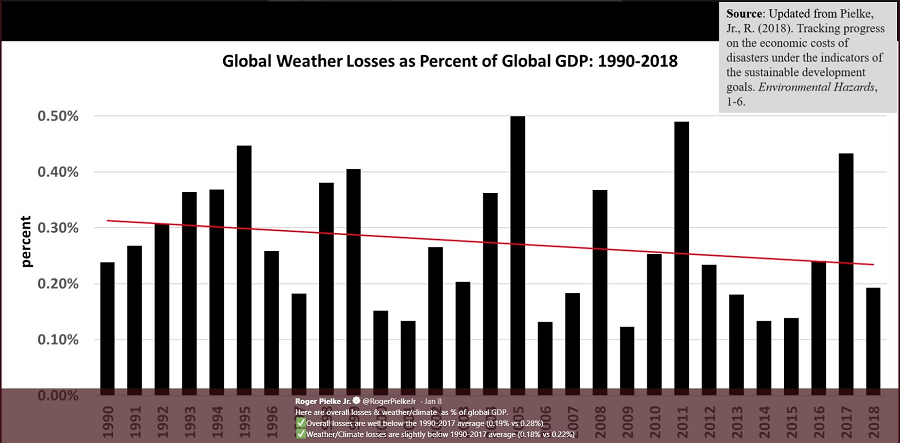
The past three decades are generally agreed to be the warmest in the instrumental record. Yet during that period, damages due to all forms of extreme weather as a share of global GDP declined. In other words, despite there being many more people and lots more stuff in harm’s way, the relative economic impact of extreme weather is decreasing. It is difficult to reconcile that trend with claims that ours is an “unsustainable” civilization.
Lomborg provides an even more telling rebuttal point in a previous Tweet. Since the 1920s, atmospheric carbon dioxide (CO2) concentrations increased from about 305 parts per million to more than 400 ppm, and global average temperatures increased by about 1°C. Yet globally, the individual risk of dying from weather-related disasters declined by 99 percent.

Stigletz claims we cannot afford not to spend trillions to mitigate climate change because “our lives and our civilization as we know it is at stake, just as they were in World War II.” Lomborg notes that in the peer-reviewed literature, unchecked climate change is estimated to cost 2-4 percent of global GDP in 2100. That “is not the end of the world,” especially considering that, despite climate change, global per capital incomes in 2100 are expected to be 5-10 times larger than today.
Ironically, in the “socio-economic pathways” (SSPs) literature, the richest SSP is the one that relies most on free markets and fossil fuels.

Source: Keywan Rhiahi et al. 2017. “This world [SSP5] places increasing faith in competitive markets, innovation and participatory societies to produce rapid technological progress and development of human capital as the path to sustainable development. . . . At the same time, the push for economic and social development is coupled with the exploitation of abundant fossil fuel resources and the adoption of resource and energy intensive lifestyles around the world.”
John Christy’s new paper, published by the Global Warming Policy Foundation, summarizes two of his recent peer-reviewed studies. In 2017, Christy and fellow atmospheric scientist Richard McKnider examined 37.5 years of satellite data in the global troposphere (bulk atmosphere). Christy and McNider factored out the warming effects of El Ninõ and the cooling effects volcanic aerosol emissions. The underlying greenhouse warming trend—the dark line (e) in the figure below—is 0.095°C per decade, or about one-fourth the rate forecast by former NASA scientist James Hansen, whose congressional testimony launched the global warming movement in 1988.

Christy and McNider estimate that when atmospheric carbon dioxide concentrations double, global warming will reach 1.1°C—a quantity called “transient climate response.” Christy comments:
This is not a very alarming number. If we perform the same calculation on the climate models, you get a figure of 2.31°C, which is significantly different. The models’ response to carbon dioxide is twice what we see in the real world. So the evidence indicates the consensus range for climate sensitivity is incorrect.
In 2018, Christy and economist Ross McKitrick set out to test the accuracy of climate models. They examined model projections in the atmosphere between 30,000 and 40,000 feet, in the tropics from 20°N to 20°S. The atmosphere warms fastest in that portion of the atmosphere in almost all models used by the U.N. Intergovernmental Panel on Climate Change (IPCC), such as the Canadian Climate Centre model, shown below.

In 102 model runs, the average warming in the “hot spot” portion of the tropical atmosphere is 0.44°C per decade, or 2°C during 1979-2017. “However, the real-world warming is much lower; around one third of the model average,” Christy reports.

Christy sums up the test results:
You can also easily see the difference in warming rates: the models are warming too fast. The exception is the Russian model, which has much lower sensitivity to carbon dioxide, and therefore gives projections for the end of the century that are far from alarming. The rest of them are already falsified, and their predictions for 2100 can’t be trusted. If an engineer built an airplane and said it could fly 600 miles and the thing ran out of fuel at 200 and crashed, he wouldn’t say ‘Hey, I was only off by a factor of three’. We don’t do that in engineering and real science. A factor of three is huge in the energy balance system. Yet that’s what we see in the climate models.
Statements like the following are increasingly common in popular media, academic journals, and political discourse: “The evidence that anthropogenic climate change is an existential threat to our way of life is incontrovertible.” Not so—not even close.
Two pieces
Is the EU imploding.
https://www.spiked-online.com/2019/05/24/the-eu-is-an-empire-in-decay/
On Indiana Abortion Laws
A few thoughts on the EU Elections by Tom Donelson
My own view of EU elections in part. In Great Britain, the Brexit party dominated in all sections of Great Britain with the exception of Scotland, where SNP won. Tories biggest loser, Labour not far behind and Lib Democrats the biggest supporter of remainers.
In France, Le Pen won barely over Macron who was the biggest loser but Le Pen own percentage similar to what she got in the first round last Presidential run. It wasn’t a massive victory for her but a big defeat for Macron.
In Germany, it was the Green Party the big winner and the major parties the biggest losers. If Brits stay right of center, Germany moving left and France populist but not necessarily free market since Le Pen is hardly a free marketer.
By Larry Fedewa
Conscious Capitalism:
The Moral Case (Part I)
Updating workers’ rights
By Dr. Larry Fedewa (May 25, 2019)
Until now, we have been exploring the case for Conscious Capitalism on the basis of economic necessity. It is clear that the strength (68%) of America’s economy is based on consumer demand. Most of the consumer purchases in America are bought by the families of the middle class, because there are more of them and because their needs tend to cover a wide spectrum of goods and services. It is therefore critical that a majority of Americans have enough money to buy an ever-increasing supply of consumer goods and services if our economic engine is to keep on growing.
But the fact is that more and more of the available capital is ending up in the hands of the very rich, leaving the vast majority of the population with less and less disposable income. However, the consumer needs of the very rich are limited; most of their spending goes for investments and passive income. In order for our economic progress to continue to prosper, therefore, something must be done to distribute more of America’s wealth to a larger proportion of America’s population. The alternative is the eventual destruction of the capitalist system which has worked so well for us for the past two centuries.
There are only three alternative ways to redistribute America’s wealth: 1) do nothing and continue to rely on the “free market” to distribute our wealth equitably – which it never has in human history; 2) empower the Government to collect more of the money being earned by American businesses (through high taxes on the very rich) and then being responsible for dispensing those funds as it sees fit (usually through welfare programs), or 3) reform of our capitalist system to provide for re-distribution of profits as an outcome of the normal way of doing business. While many Americans would prefer to achieve greater financial success through their own efforts rather than through a government hand-out, the mechanism by which that result can be implemented has remained elusive.
Fortunately, a new system of capitalism has been undergoing development for the past generation and has now matured into a new view of business and its role in social justice. The basis of this movement has been recognition of each worker as an individual human being, deserving of respect, loyalty, and appropriate rewards for his/her contribution to the enterprise. In the 1980’s, W. Edwards Deming introduced a democratization of the production process called Total Quality Management (TQM).
This theory depended on recognition of the ideas and creativity of workers, initially on a production line, to improve the quality of the final product. As “product quality” became a major consideration in American business culture, it was frequently presented in the context of greater worker involvement. This movement spun off ever more sophisticated standards of product quality such as Six Sigma, ISO 9000, and Lean Manufacturing, among others. These “new” management theories for production also began to be applied to services organizations. I was personally involved in introducing TQM (as amended) to the federal government during the late 1980’s and 1990’s.
This formal focus on the individual worker was picked up and expanded by a new movement called “Conscious Capitalism” in the new century. This management theory is profoundly democratic, in that every member of the enterprise is recognized as a contributor to the common effort and is responsible for participating in the culture and the activities associated with that particular organization. This includes open meetings on finances, policies and strategies. A bedrock belief of a Conscious Capitalist is that profit is not the purpose of the business, but a necessary pre-condition for the achievement of the true mission of the company.
The mission, in turn, is viewed in the context of the company’s contribution to the larger society by counting as the company’s stakeholders not only the shareholders, but also the employees, the local community, their suppliers, customers, and the physical environment.
“Conscious companies” (as they call themselves) have been proven on average to be surprisingly successful in financial terms because of several factors. First, their marketing is supported by faithful, long-term customers and suppliers. Second, their personnel costs are demonstrably less because of lower executive compensation, lower turnover, “lean” middle management, and lower G&A overall, including less legal fees. Finally, these companies do not accept investors who are on a short fuse for ROI – in fact many of their shareholders are their own employees. (A very comprehensive source for becoming and maintaining a conscious company can be found in Conscious Capitalism Field Guide, by Raj Sisodia et al, Harvard Business Review Press, 2019)
The underlying factor in conscious companies is their insistence on a long-term rather than short-term perspective which is then translated into policies and actions. Some of the more prominent conscious companies are Federal Express, Southwest Airlines, Whole Foods Markets, Starbucks and 1600 others with three million employees.
That is a very brief description of a non-governmental re-distribution of wealth. There is, however, an additional case for profit-sharing: the moral case.
The moral basis of profit-sharing as the foundation of a new interpretation of “Workers’ Rights” is the paradigm of a product. A product is composed of many parts, and it is the result of many contributors, i.e. the concept, the design, the assembly of the materials, the fabrication of the parts, the assembly and testing of the prototype (and perhaps each copy), as well as the marketing, sales, warranty services, replacement parts, etc.
Our moral contention is: Compensation should be granted on the basis of how much each person contributed to the entire process.
There are direct contribution costs, based on financial requirements of the people , materials and equipment. Then there are “success” and “failure” compensations based on the presence or absence of profits – the measure of the success (or not) of the project. These compensations also should be shared according to the contributions made by the individuals involved.
The traditional basis for employee pay is hours worked. The new worker’s rights include a new basis: pay on the basis of employee’s contribution to the overall profit of the business. The detail of calculating exactly how to measure each person’s contribution to the company is truly a challenge. But the principle is simple, easy to understand – and the key to America’s future.
© Richfield Press 2019. All rights reserved.
Thoughts on the by Tom Donelson
I tweeted two pieces on the failure on EU and its implosion. A few thoughts. Over the past 70 years the most unifying force was NATO as a community of nations backed by US defended their freedom and in the end, they succeeded.
If the EU had followed by the advice of Margret Thatcher in his speech at Burges in 1988 the EU become a community of nations recognizing each nation sovereignty and work on common defense, the very forces of populism will not have arise and Great Britain would be part of a Europe tied to the United States.
EU using the Euro, tied the Europe to institutional control with a parliament that can’t pass law but merely rubber stamped the EU bureaucratic rules. The elites now want a more centralized institution complete with its own army and foreign policy.
I detailed this in my book https://posthillpress.com/book/the-rise-of-national-populism-and-democratic-socialism-what-our-response-should-be … and noted the intellectuals wanted a Europe independent of the US but not all nations want a more powerful EU and dream of a Europe that is a community of nations.
The EU is becoming the enemy of liberty and will split Europe from the US and in the end, the goal of a peaceful Europe will be torn asunder by EU elites.
 The Donelson Files