|
|

|
|
|
|
| may 2nd | may 23rd | May 30th | June 6th | Death per capita | |
| South Dakota | 6% | 5.60% | 4.50% | 4.60% | 83 |
| Utah | 6.20% | 5.30% | 5.10% | 5.10% | 40 |
| Idaho | 8.70% | 6.70% | 5.90% | 5.60% | 48 |
| Nebraska | 6.90% | 6.40% | 6.10% | 6.10% | 101 |
| Arizona | 7% | 7% | 6.20% | 6.20% | 155 |
| Wyoming | 7.20% | 7.20% | 6.50% | 6.30% | 31 |
| Indiana | 9.60% | 8.50% | 7.80% | 7.40% | 354 |
| Kansas | 9.70% | 8.20% | 7.90% | 7.60% | 83 |
| Missouri | 9.40% | 9.20% | 8.20% | 8% | 142 |
| Maryland | 8.80% | 8.60% | 8.30% | 8.50% | 476 |
| Alabama | 10.60% | 9.50% | 8.90% | 8.50% | 154 |
| Colorado | 8.10% | 8.80% | 8.10% | 8.70% | 276 |
| Arkansas | 9.50% | 9.30% | 8.80% | 8.80% | 55 |
| Montana | 12.40% | 9.80% | 9.40% | 8.90% | 17 |
| Wisconsin | 11.40% | 10% | 9.50% | 9.10% | 115 |
| North Dakota | 11% | 9.60% | 9.50% | 9.30% | 97 |
| Texas | 9.80% | 10% | 10.80% | 9.30% | 66 |
| Ohio | 13.20% | 11.30% | 10% | 9.40% | 211 |
| Virginia | 9.80% | 9.80% | 9.60% | 9.50% | 178 |
| Tennessee | 11.10% | 10.40% | 10% | 9.70% | 64 |
| South Carolina | 12.70% | 11.10% | 10% | 9.70% | 112 |
| Iowa | 11.90% | 11.30% | 9.90% | 9.80% | 203 |
| Florida | 5.70% | 6.50% | 7.80% | 10% | 122 |
| Oklahoma | 12.10% | 9.10% | 11.20% | 10.90% | 90 |
| North Carolina | 13.10% | 11.80% | 11.30% | 11% | 105 |
|
|
|
There have been some great governors who understood the data and got the response right, Ron DeSantis and Kristi Noem were two of those. Most governors have meddled through in some cases just lucky but there are governors who quite frankly blew it.
I will give the Donelson Files list of governors who shouldn’t ever be re-elected.
Among those governors begin with Walz of Minnesota who has been complete failure in handling the unrest in his states and his reponse to the virus. Minnesota has closed the economy and all of the red states in his region have out performed him. Only Michigan has done worse.
Cuomo policy of forcing nursing homes to accept covid sick patients in nuring home and this killed thousands. Cuomo then changed the procedure on counting Nursing home deaths to make him look better and now has scrubbed the original order. He has Debasio complete disaster administration to make him look better but his policy is responsible for the death of thousands.
Governor Whitmer has been equally as incompetent as Walz which is why she was consider a prime candidate for VP slot. Incompetence is not a disqualification in the Democrat party. She has killed seniors with her policy and acted like a little dictator.
I will put Charlie Baker, the governor of Massachuesetts the Republican who adopted the Democrat method of combatting the virus and his death per capita speak for itself
Note how the main stream media have bad mouth the recent unemployment numbers by essentially saying they didn’t happen. For those who have followed my timeline would have not have been surprised.
First is that unemployment claims for the past five weeks have been dropping across the country. 75% of the states saw drops.
Second, that those states that open up quicker reduction in claims and the top eight states with the LOWEST unemployment claims were red states.
Third Nor any evidence that red states put their citizen at risks by opening up quick as no significant increase in death per capita versus Blue states. Top 10 out of 13 states with highest death per capita are blue states with Democrat governors.
Two of the states Republicans are governors, include the nominal blue states Maryland and Massachusetts that have heavy Democrat control of the legislatures. They have done as poor of job protecting their citizens as blue governors.
Red States overall have done a superior job in protecting their citizens and helping their citizens keep their jobs. Data has spoken.
| What the hell is going on? |
 |
| Miami Florida (May 31, 2020) Stealing, burning, and shooting have nothing to do with the murder of a poor civilian! By Dr. Larry Fedewa(Washington DC, May 31, 2020) There’s hardly a need for another rant about the need for law and order to fight the chaos America has seen the last few nights. So, I will ask another question, Where were the police? In city after city, the rioters are being allowed to ravage whole neighborhoods with not a cop in sight. Even though most cities have access to their National Guard, none were used even to limit, let alone stop the mayhem. Here in Washington DC, the Secret Service were out in force to protect the White House – which they did — so the crowd was moved on to wreak havoc elsewhere. Other cities do not have a Secret Service, but they do have other outside resources including the State Police and the National Guard. Minnesota actually called in the State Police, as presumably other states did also. So, where were they when the trouble started? Are we facing a national revolt by police departments in addition to all our other problems? If so, they aren’t telling anyone. The absence of police protection violates the most basic of all the responsibilities the police take when they are sworn in – to keep and maintain peace. How can they justify their lack of enforcement during this crisis? The answer seems to be that the law enforcement establishment in general was woefully unprepared – in resources, manpower, and psychologically – to deal with such an uprising as we have seen for the past week. If so, this shows an absence of planning which is not only incompetent but — after Ferguson, Baltimore, and other such events – rises to the level criminal negligence. To blame the departments, however, may miss the true target. Behind the public safety departments stand the budgets, and budgets are the responsibility of the elected officials, starting with the mayor. Over many years the governance of most American cities has been a “high tax, low service” operation, perpetually overspending, frequently corrupt, and also frequently biased against its own public servants, especially the police. Wherever the responsibility for public safety lies, the fact is that it has been proven to be grossly incompetent by this latest urban crisis. The second question will undoubtedly be debated for years to come, namely, What is motivating the rioters? The first distinction to be made in considering this question is between the protestors and the rioters. The protestors far outnumber the rioters. Their cause is legitimate and protected by law. Ostensibly, the reason for the protest was what appears to be the cold-blooded murder and subsequent lack of punishment of George Floyd’s killers. Clearly, the right to protest is guaranteed by the Constitution of the United States. As far as I know, no one has been denied that right. But then the rioters showed up and began looting and violent attacks on persons and property – including some law enforcement officers. This behavior violates every rule of law and has nothing to do with the tragic murder of George Floyd. Rioting undermines the message of the protests. It has been established by such legal arrests as have been made that the rioters are mostly out-of-town imports present for the purpose of doing what they did. Whether they were paid has not yet been established, although past experience says that they were. If so, by whom? Various suspects come to mind, including foreign agents, such as Iran or China. Left to their own devices, without any opposition from the police – at least in the first several nights – they created an urban jungle, a state of barbaric chaos, ruled by violence and senseless attacks on stores and anyone who tried to stop them. Witnesses tell of the coordination which existed among them, with radio communications, weapons, and Molotov cocktails. This is the Antifa that the President has condemned. But there may also be another group. These would be local criminals who have suffered with the rest of us through the lean times of the lockdown. After all, burglaries, smuggling, and prostitution are not viable when there is no traffic anywhere, with all homes being protected by their omnipresent owners. It seems quite likely that by the second night of the Apocalypse, these outlaws were ready with their masks, battering rams, unmarked cars and designated targets to proceed to the greatest hauls of their lives, tons of expensive products available virtually for the taking, for s few hours’ work, night after night. After all, what good to a poor kid is a $2,000 bicycle? He can’t take anywhere without arousing suspicion. And odds are he doesn’t know a fence who would give him a reasonable price. The same for jewelry, clothes, furs, athletic equipment, and prescription drugs – all of which were lost to rioters. This smells of organization and local knowledge. So, what now? For one thing, a lot of innocent people have been hurt by this last episode in what is shaping up to be the worst year since 2001, or maybe 1968. First a pandemic, then a three-month national lockdown, followed by a tenuous recovery, and now chaos in the streets. We can’t help asking, What’s next? Well, as we gradually try to recover from this breakdown of public order, we have to remember that the so-called recovery was just getting started. No one knows how that is going to come out. This past week is certainly going to slow things down- — maybe kill the recovery for many businesses which were already in deep financial trouble. In which case we may be in for an extended and perhaps very severe recession. Another possible outcome of this national catastrophe could be a virulent resurgence of COVID-19, exacerbated by all the crowds of demonstrators, most of whom showed little regard for the danger of contamination – – except for the handy disguise of the masks. One good thing may be in our sights now: the serious attention that should be shown to the cause of racial inequality before the law. This is part of an ongoing cancer in American society. Of course, there have been several other incidents in recent history which pointed to the same problem, Let’s hope that this time we can get it right. In any event, our lives are not going to stop because hard times are upon us. We have to keep going. To find the strength to keep on keeping on, we have to dig deep into our own souls and find that ultimate force within which makes us stubborn in our hope. For most of us, that bedrock is love. Love of our family, our nation, and over it all love of our God Who gives us that strength. It is there someplace. We have to find it; then we can live by it! It is the key to our survival. © 2020 Richfield Press. All rights reserved. |
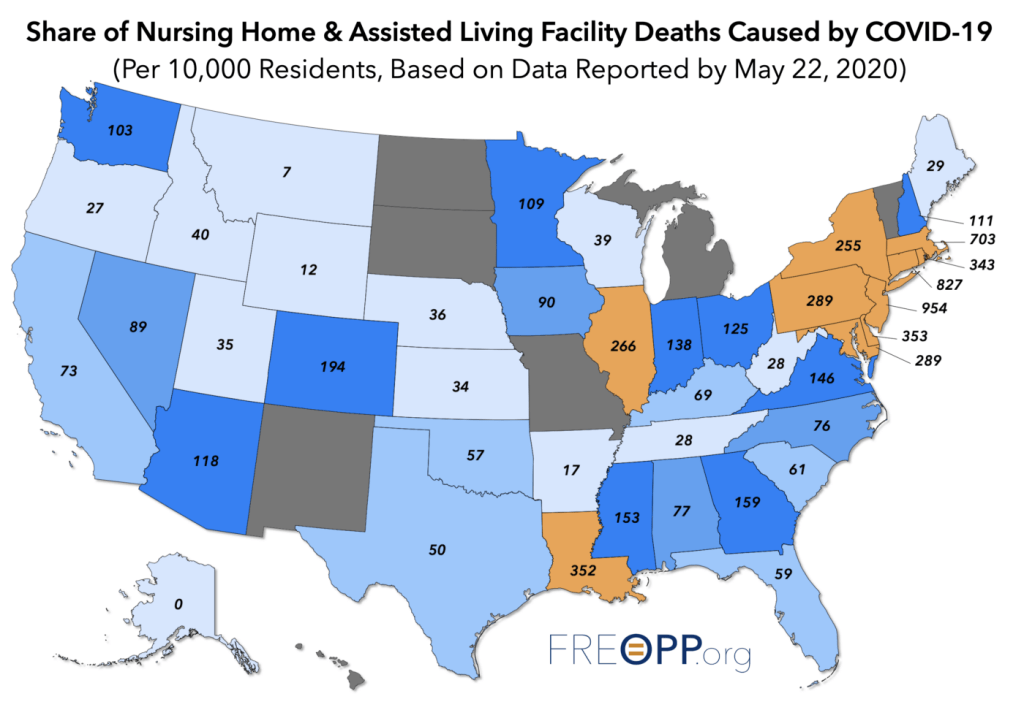
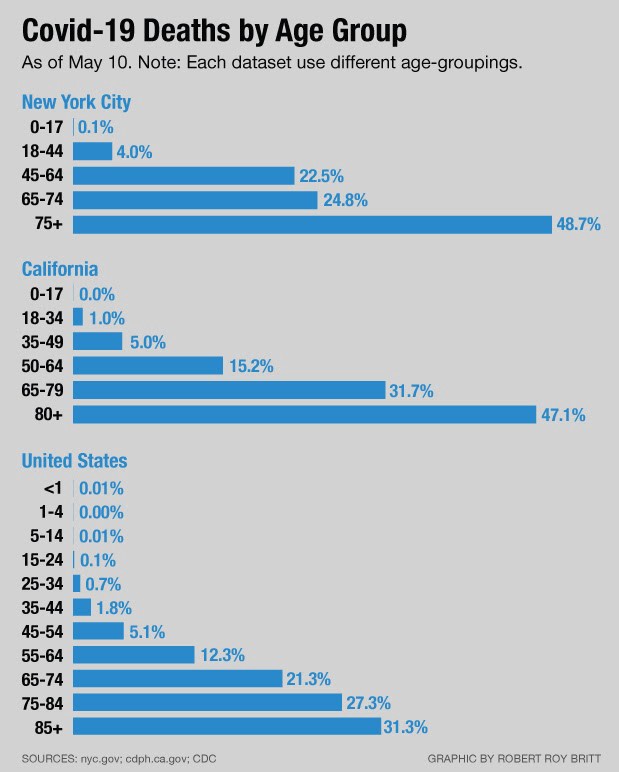
In the United States, we have seen 105,000 deaths from Covid virus but 91% of deaths are patients 55 years and old, and vast majority of these patients have co-morbidity. 30 to 42 percent of those who have died, resided in nursing homes. This represent 31,000 to 43,000 deaths from less than one percent of the population and more than 95,000 people who have died overall are over the age of 54 mostly with co-morbidity.
We can play Monday morning quarterback but in reviewing the past performance, we can do a better job of planning for a second wave this winter if it happens. In the United States, the number of those who have died under the age of 55 is less than 10,000 and those 24 and under is 1,000, if not less.
Florida and New York followed different strategy in dealing with their outbreaks. Florida concentrated on reducing mortality in nursing homes whereas New York chose to do the complete opposite and even forced nursing homes to take Covid patients back in nursing home. On a per capita basis, Florida has seen fatality rate one fourth of New York in nursing home. If much of the United States adopted Florida strategy in reducing the virus among the elderly, we may have seen a 75% reduction in mortality among nursing home patients. That would have saved 23,000 to 32,000 lives alone and if we concentrated our efforts on those over 55, we would have not only have saved lives but reduce the overall numbers of Covid-19 deaths as well as reducing usages in our hospitals. If we reduced the overall mortality of those over 55 by half including nursing homes, we would have saved 48,000 lives. There is a distinct possibility that a partial opening sooner may have seen an increase in numbers of Covid infections among younger patients, the number of deaths would not have increased substantially. An increase of 20% overall confirmed infections would only add at most 500 overall deaths under the age of 55. So maybe we could have seen significant reduction of overall mortality. Just doing the Florida strategy on nursing home would have saved a net 22,500 to 32,500 lives.
The second point would be the economic data. In April, we had 14.7% unemployment rate and the big questions would a quicker partial reopening led to less economic dislocation and less unemployment?
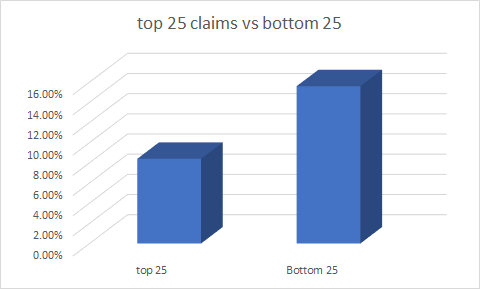
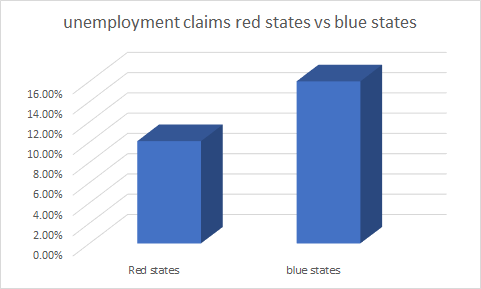
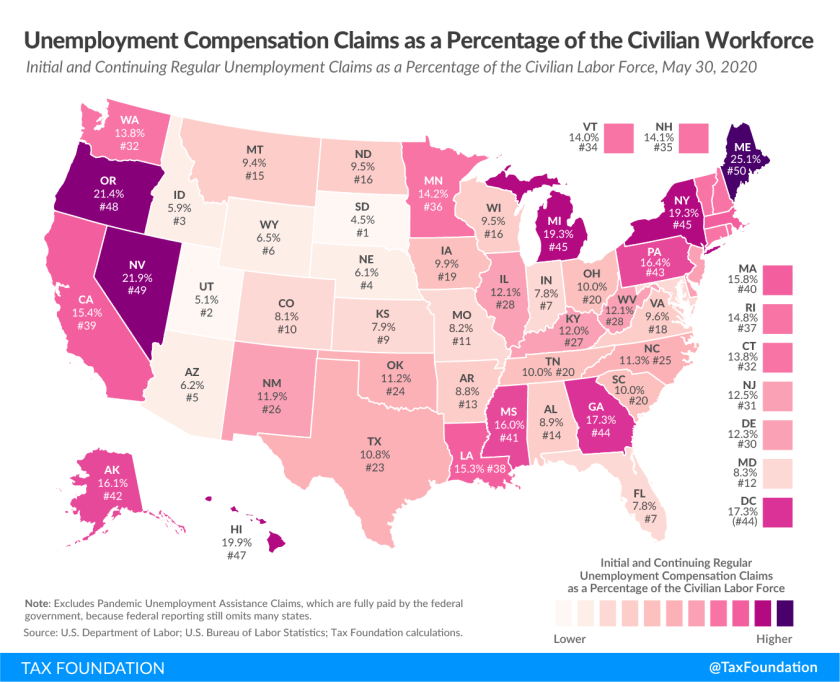
In reviewing the most recent unemployment claims, we find that the average of the top 25 for lower unemployment claims was 8.4% whereas the bottom 25 plus DC was 15.6%.
Both Utah and South Dakota never imposed a shelter in place and partially reopen their economy quicker. For the past four weeks, Utah and South Dakota averaged 5.8% and 6% unemployment and they had ranges from 5.3% to 6.3% over the past four weeks. New York and Michigan which had stricter shelter in place and have been behind in opening their economy. New York has averaged 21.25% unemployment claims and Michigan has averaged 21% over the past four weeks. These states had ranges from 20.3% to 22.5% in unemployment claims.

I then compared unemployment claims between two Red States, Texas, and Florida with two Blue States, New York, and California. California had unemployment claims ranged over the past four weeks 12% to 26.4% compared to Florida ranges of 5.7% to 22.4%. Both states have not yet seen a defined pattern but overall California has averaged 18.5% unemployment claims for the past four weeks versus Florida 11.1%. Florida has begun their reopening sooner and California is still struggling with designing a reopening plan. Florida overall unemployment claims are lower and both states are similar to death per capita with California slightly lower.
Texas and New York have had more consistent ranges and Texas unemployment claims have averaged 9.8% vs. New York 21.21%. More importantly, Texas has the lowest death per capita than the other three states and both Florida and Texas overall death per capita is significantly lower than California and New York combined. The trend within Florida and California is hard to digest but Florida economic numbers appear to be better than California and Texas have one half of the unemployment claims than New York.
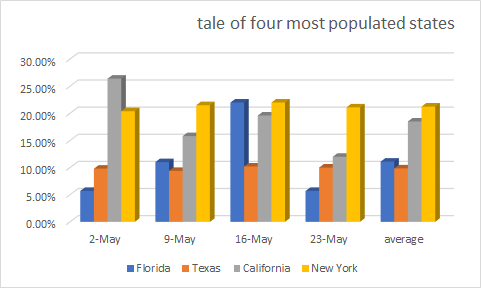
19 of the top 25 states are states with Republicans governor even though one of those states, Maryland can easily be categorized as a Blue State and both Kansas and Montana, two states with Democratic governors can easily categorized as Red States. The top seven in lowest unemployment claims are Red states run by Republicans. We have seen that among four of the most populous states, the Red States have nearly one-half of the unemployment claims than two blue states just as we have seen top 25 states are one-half of the bottom one-half states.
States with Republican Governors average 10% unemployment claims compared to 16% in Blue states. While unemployment claims may not equal unemployment rates, there is no doubt that by reopening states earlier and not having a shelter in place did less damage to various state economies. One conclusion we can make is that those states that open up sooner plus those few states that never activated a shelter-in-place had less unemployment claims.
The number one lesson is that shutting down the economy has a far more negative impact on the economy than keeping the economy partially open. This lesson needs to be heeded if we hit a second wave later in the year.
The second lesson is that the number one priority of state and local officials is to concentrate efforts to reduce the death rates among the seniors and those with co-morbidity, encourage the most vulnerable to protect themselves by staying in shelter, wearing mask and encouraging social distancing. I will estimate that we would have reduce the overall morality rate by at least 25% and maybe closer to 50% had states followed those strategies across the board from the beginning. Those who are the least vulnerable should be allowed to work.
When we do have a vaccine available, those over 55 with co-morbidity get vaccinated first.
While I can’t judge exactly what the unemployment rates would be but I will guess that it would be between 7 to 9 percent and if we followed the Florida strategy of dealing with the virus, we could have saved at least 23,000 to 48,000 lives.
This analysis is just a beginning and there is more data to collect including hospital utilization rates and its impact on other aspect of health care. What has yet to be measured is the impact on the overall health care system as many “non-essential” services have been first been prohibited and then delayed. This has led to lay offs for many hospitals and medical centers while delaying medical care for serious treatment of other ailments. How many patients have died of heart attacks due to lack of treatment, how many illnesses left untreated from cancer to heart disease will shorten life? There have been report of increase suicides as result of the economy’s decline. These impacts also need to be reviewed and if we reduced the number of seniors dying, we not only reduced hospital utilization for Coronavirus but also allowed other disease to promptly treated. Others can follow up on my own theory that a different strategy would have saved many businesses from being shut down, reduce unemployment, and reduced overall deaths to Coronavirus. And if my theory is correct, then we must use a totally different strategy if we have a second wave later this year or early next year.
Recovery in partisan crosshairs; New conspiracy evidence; China fighting back!
By Dr. Larry Fedewa
(Washington DC, May 24, 2020) – As if quarantine and recovery were not enough to worry about, Americans have other headlines competing for our attention. Most tiresome is the conflict between those who want to resume economic activity as much as possible and those who don’t. At issue is the frustration experienced by everybody at the lifestyle we have been forced to adopt because of the threat of the COVID-19 pandemic – everybody staying home while their jobs and earnings dwindle away.
Recovery in partisan crosshairsA vocal minority has rebelled openly against the closed-door policies of many jurisdictions which have been slow to authorize the back-to-work recommendations of the President. Some are claiming that these restrictive mandates violate the basic rights guaranteed by the Constitution. Others are desperate for an income, still others are just tired of the inactivity. None of this is too surprising given the circumstances.
The surprising part comes when many leading Democrats began advocating the stay-at-home crowd, claiming that the plague is still too widespread to admit the proximity of daily life encounters in businesses and churches. They blame President Trump for sloppy management of the national response, apparently because he has instituted a “go-local” approach economic recovery.
They claim that there should be a “one size fits all” federal policy for the recovery, even though there is a vast disparity between the various local circumstances. This is not really a credible solution to the problem of managing the national opening of doors. But it gets serious when the House of Representatives passes a bill aimed at financially supporting the closed economy in the name of public safety from the virus. How do you deal with ridiculous proposals which are advanced by one of the highest authorities in the land?
New conspiracy evidenceThen, just when we are beginning to deal with that idiocy, we find out that President Obama may have been intimately involved in the attempted overthrow of his successor. The Dems are losing their minds over this one. The current administration has released some very incriminating documentation of testimony kept hidden for as long as two years by Adam Schiff, Jerrold Nadler, and Nancy Pelosi. These documents in effect begin to substantiate the assumptions of the President’s supporters that the attempted coup d’état which led to the impeachment trial of Donald Trump was in fact a treasonous conspiracy to overthrow the legitimately elected President of the United States.
China fights backThis is very serious stuff, but it is hard to concentrate on it when you are facing financial ruin because of a lost job or business. But if you are able to devote sufficient attention to these two political issues, there’s still another one brewing which is equally important but just about, as they say, “a bridge too far”.
This is the mounting tension between the USA and China. The war of words is getting more and more aggressive. More importantly, the Chinese are increasing their military threats to American shipping and air surveillance. Unless cooler heads prevail on both sides, this is the kind of rhetoric that can lead to war.
America is already taking on many of the policies which characterized our Cold War with Russia for two generations. But China is a different opponent. It is better positioned to engage in an economic and diplomatic rivalry not only because of the leverage of its huge market, but also because it is much more familiar with the intricacies of the American corporate and technological infrastructure, having worked closely with American firms and government departments and personnel (including Joseph Biden and family) for the past forty years (since the collapse of the Soviet Union).
Those relationships are wide and deep, including not only corporate partnerships but also generations of Chinese students educated in American universities, as well as the capture of America’s technological base, and the purchase of US public debt.
We do not want this cold war to turn into a hot war not only because of the tragic cost to all concerned, but also because it is not at all clear that we would ultimately win such a war. China’s space and long range weapons technologies are arguably superior to our own, especially since, unlike China, we have not been preparing for war over the past two decades and in fact let our military capacity deteriorate to an alarming extent during the Obama years.
The Steve Bannon hawks need to think through again their anti-China positions before someone starts shooting. Yesterday’s fall of Hong Kong may be just the provocation to precipitate Western action. Things are getting very tense.
What can you do?So, that is the menu of top issues facing America. The question is, how do we deal with all these problems? Do we just decide to let the powers that be resolve everything? Do we pick a cause and go all out to support it with demonstrations, social media campaigns, and all the modern communications technologies?
There is an ancient prayer which includes the words,” Lord, give me the strength to accept things I cannot change, the courage to change the things I can, and the wisdom to know the difference.” Good advice in these troubled times.
Look past the words at the actions
By Dr, Larry Fedewa(Washington DC, May 17, 2020) – As the saying around Washington goes, “President Donald J. Trump frequently steps on his own message”. Nowhere is that observation more accurate than in the matter of his leadership during the current crisis. His verbal descriptions of the steps he has taken and the reasons for each step sound a lot like bragging – even, at times, a plea for credit. But in few cases do they clearly and accurately convey either the obstacles or the strategy that led to these decisions – both of which have been significant.
Let’s do a brief recap. The COVID-19 pandemic has thrown the country into the worst crisis since Pearl Harbor. The President started our national response virtually alone. As the crisis began to take shape, he enlisted the aid of the public health experts, the national laboratories, the privately-owned laboratories, then the hospitals, the manufacturing industry, and so on, as new requirements arose, one after the other.
When called upon, these Americans put aside their personal feelings and opinions about politics and proceeded to perform nearly miraculous feats –as when the Army Corps of Engineers created a hospital in Central Park in three days!
What inspired this sensational cooperation? Trump’s mixture of salesmanship and pressure. The appeals of the President to the patriotism of the participants would not have been sufficient to effect the desired outcomes had the President not presented each group with specific, well-thought-out tasks which fit the capabilities of each party. This is called detailed planning.
The result was that each party was asked to do something they knew how to do and were capable of doing. And, in problem after problem – from medical supplies to hospital beds to pharmaceuticals to supply chains to manufacturing — the results were astonishing.
Then the President organized the governors of the 50 states and the territories into the most important role they have ever played as a group – perhaps in American history! Even the bitterest critics of the President joined the coalition and developed a working relationship with the federal administration and the President and Vice President (a former governor).
We witnessed the greatest example of federalism in the history of the Republic – James Madison would have been proud the see it in action. And there were also side effects of this strategy.
First of all, it was the most practical solution to the extremely complex problems of a national recovery which featured thousands of varying local circumstances and conditions. Clearly, the Democrats’ call for a “national” one-fits-all policy would not work.
But that observation reveals another side effect. By sticking to the Constitution, the President’s approach also made those criticisms of the opposition so obviously misguided that even the friendly Press disregarded them.
In all, we saw the most impressive example of presidential leadership perhaps since Franklin Roosevelt in 1933.
The Press, of course, missed this amazing spectacle which was unfolding before their very eyes. For the most part, those eyes were blinded by the same unthinking bias which had caused them to join the Dems’ insane attempt to overthrow that presidency earlier this year.
I have commented in the past that other speakers, such as Vice President Pence, frequently describe the President’s actions more clearly and convincingly than does the President himself. However, the forum does make a difference.
The President is very effective during his famous rallies in describing the mountains he has climbed as president and the results he has achieved. In fact, his ability to attract and entertain thousands of people in his rallies is unparalleled in modern politics. In this realm only entertainers can compete.
This ability is so unique that any discussion of Donald J. Trump’s communication skills must begin with his rallies. Next would be his set speeches which have improved with practice and since he learned to use the teleprompter. Finally, would be his impromptu press briefings on his way to the airport. But his formal press conferences not so much.
In the end, of course, as the Bible says, “By his works you shall know him.”
© 2020 Richfield Press. All rights reserved.

 The Donelson Files