Donelson Files is a podcast that features politics, culture and entertainment. The webpage will include writers from right to left, discussing politics, sports, entertainment, culture and include photos, art and poetry.
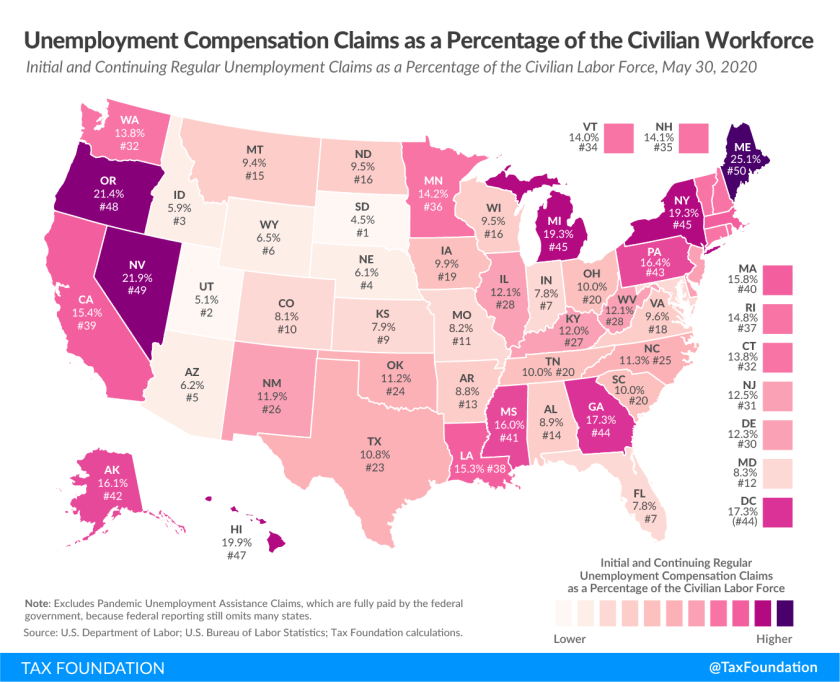
Note how the main stream media have bad mouth the recent unemployment numbers by essentially saying they didn’t happen. For those who have followed my timeline would have not have been surprised.
First is that unemployment claims for the past five weeks have been dropping across the country. 75% of the states saw drops.
Second, that those states that open up quicker reduction in claims and the top eight states with the LOWEST unemployment claims were red states.
Third Nor any evidence that red states put their citizen at risks by opening up quick as no significant increase in death per capita versus Blue states. Top 10 out of 13 states with highest death per capita are blue states with Democrat governors.
Two of the states Republicans are governors, include the nominal blue states Maryland and Massachusetts that have heavy Democrat control of the legislatures. They have done as poor of job protecting their citizens as blue governors.
Red States overall have done a superior job in protecting their citizens and helping their citizens keep their jobs. Data has spoken.
Stealing, burning, and shooting have nothing to do with the murder of a poor civilian! By Dr. Larry Fedewa(Washington DC, May 31, 2020) There’s hardly a need for another rant about the need for law and order to fight the chaos America has seen the last few nights. So, I will ask another question,
Where were the police? In city after city, the rioters are being allowed to ravage whole neighborhoods with not a cop in sight. Even though most cities have access to their National Guard, none were used even to limit, let alone stop the mayhem. Here in Washington DC, the Secret Service were out in force to protect the White House – which they did — so the crowd was moved on to wreak havoc elsewhere.
Other cities do not have a Secret Service, but they do have other outside resources including the State Police and the National Guard. Minnesota actually called in the State Police, as presumably other states did also. So, where were they when the trouble started? Are we facing a national revolt by police departments in addition to all our other problems? If so, they aren’t telling anyone.
The absence of police protection violates the most basic of all the responsibilities the police take when they are sworn in – to keep and maintain peace. How can they justify their lack of enforcement during this crisis? The answer seems to be that the law enforcement establishment in general was woefully unprepared – in resources, manpower, and psychologically – to deal with such an uprising as we have seen for the past week. If so, this shows an absence of planning which is not only incompetent but — after Ferguson, Baltimore, and other such events – rises to the level criminal negligence.
To blame the departments, however, may miss the true target. Behind the public safety departments stand the budgets, and budgets are the responsibility of the elected officials, starting with the mayor. Over many years the governance of most American cities has been a “high tax, low service” operation, perpetually overspending, frequently corrupt, and also frequently biased against its own public servants, especially the police. Wherever the responsibility for public safety lies, the fact is that it has been proven to be grossly incompetent by this latest urban crisis.
The second question will undoubtedly be debated for years to come, namely, What is motivating the rioters? The first distinction to be made in considering this question is between the protestors and the rioters. The protestors far outnumber the rioters. Their cause is legitimate and protected by law. Ostensibly, the reason for the protest was what appears to be the cold-blooded murder and subsequent lack of punishment of George Floyd’s killers. Clearly, the right to protest is guaranteed by the Constitution of the United States. As far as I know, no one has been denied that right.
But then the rioters showed up and began looting and violent attacks on persons and property – including some law enforcement officers. This behavior violates every rule of law and has nothing to do with the tragic murder of George Floyd. Rioting undermines the message of the protests.
It has been established by such legal arrests as have been made that the rioters are mostly out-of-town imports present for the purpose of doing what they did. Whether they were paid has not yet been established, although past experience says that they were. If so, by whom? Various suspects come to mind, including foreign agents, such as Iran or China. Left to their own devices, without any opposition from the police – at least in the first several nights – they created an urban jungle, a state of barbaric chaos, ruled by violence and senseless attacks on stores and anyone who tried to stop them. Witnesses tell of the coordination which existed among them, with radio communications, weapons, and Molotov cocktails. This is the Antifa that the President has condemned.
But there may also be another group. These would be local criminals who have suffered with the rest of us through the lean times of the lockdown. After all, burglaries, smuggling, and prostitution are not viable when there is no traffic anywhere, with all homes being protected by their omnipresent owners. It seems quite likely that by the second night of the Apocalypse, these outlaws were ready with their masks, battering rams, unmarked cars and designated targets to proceed to the greatest hauls of their lives, tons of expensive products available virtually for the taking, for s few hours’ work, night after night. After all, what good to a poor kid is a $2,000 bicycle? He can’t take anywhere without arousing suspicion. And odds are he doesn’t know a fence who would give him a reasonable price. The same for jewelry, clothes, furs, athletic equipment, and prescription drugs – all of which were lost to rioters. This smells of organization and local knowledge.
So, what now? For one thing, a lot of innocent people have been hurt by this last episode in what is shaping up to be the worst year since 2001, or maybe 1968. First a pandemic, then a three-month national lockdown, followed by a tenuous recovery, and now chaos in the streets. We can’t help asking,
What’s next? Well, as we gradually try to recover from this breakdown of public order, we have to remember that the so-called recovery was just getting started. No one knows how that is going to come out. This past week is certainly going to slow things down- — maybe kill the recovery for many businesses which were already in deep financial trouble. In which case we may be in for an extended and perhaps very severe recession.
Another possible outcome of this national catastrophe could be a virulent resurgence of COVID-19, exacerbated by all the crowds of demonstrators, most of whom showed little regard for the danger of contamination – – except for the handy disguise of the masks.
One good thing may be in our sights now: the serious attention that should be shown to the cause of racial inequality before the law. This is part of an ongoing cancer in American society. Of course, there have been several other incidents in recent history which pointed to the same problem, Let’s hope that this time we can get it right.
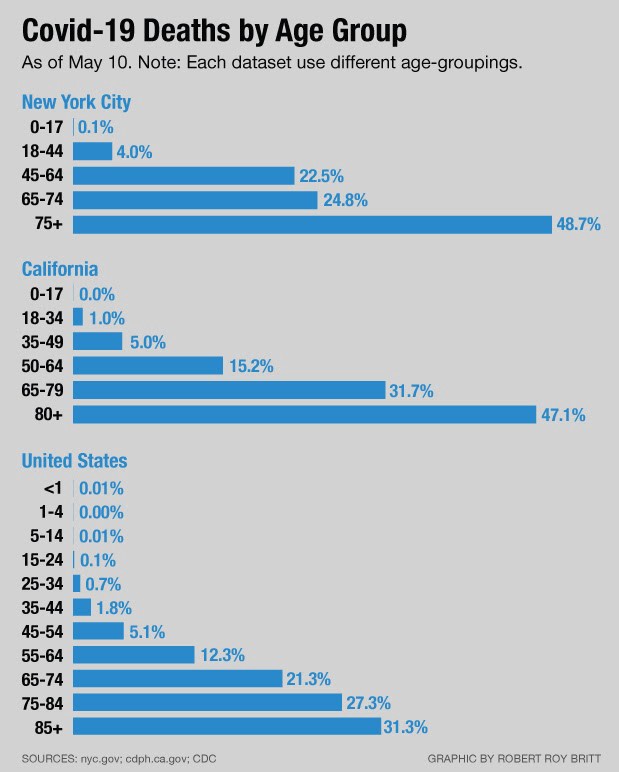
In the United States, we have seen 105,000 deaths from Covid virus but 91% of deaths are patients 55 years and old, and vast majority of these patients have co-morbidity. 30 to 42 percent of those who have died, resided in nursing homes. This represent 31,000 to 43,000 deaths from less than one percent of the population and more than 95,000 people who have died overall are over the age of 54 mostly with co-morbidity.
We can play Monday morning quarterback but in reviewing the past performance, we can do a better job of planning for a second wave this winter if it happens. In the United States, the number of those who have died under the age of 55 is less than 10,000 and those 24 and under is 1,000, if not less.
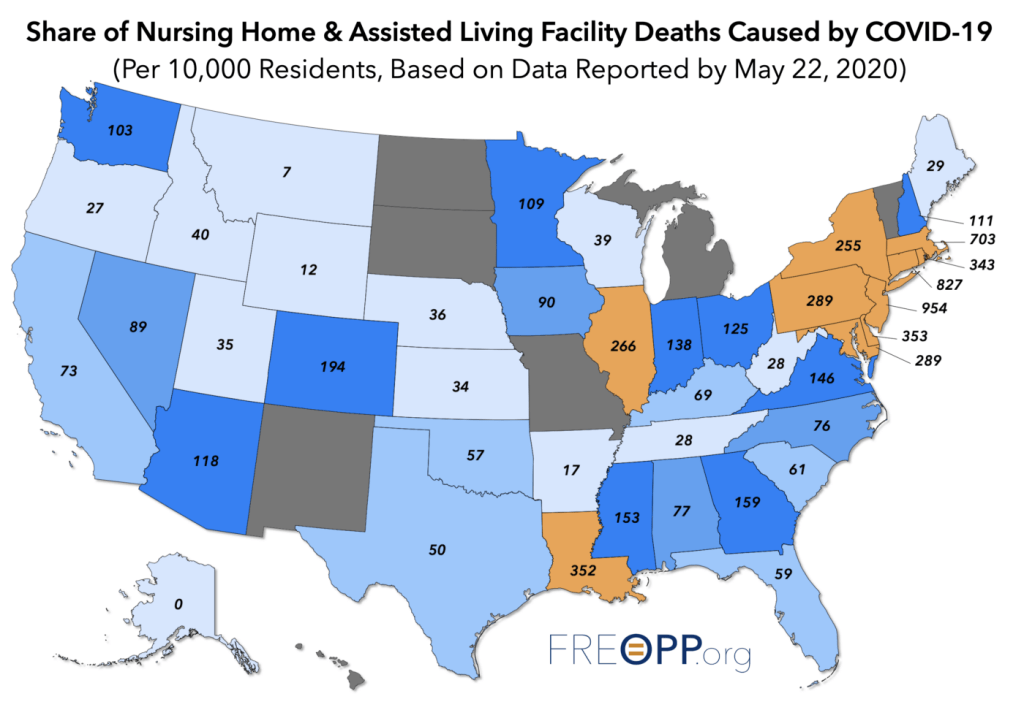
Florida and New York followed different strategy in dealing with their outbreaks. Florida concentrated on reducing mortality in nursing homes whereas New York chose to do the complete opposite and even forced nursing homes to take Covid patients back in nursing home. On a per capita basis, Florida has seen fatality rate one fourth of New York in nursing home. If much of the United States adopted Florida strategy in reducing the virus among the elderly, we may have seen a 75% reduction in mortality among nursing home patients. That would have saved 23,000 to 32,000 lives alone and if we concentrated our efforts on those over 55, we would have not only have saved lives but reduce the overall numbers of Covid-19 deaths as well as reducing usages in our hospitals. If we reduced the overall mortality of those over 55 by half including nursing homes, we would have saved 48,000 lives. There is a distinct possibility that a partial opening sooner may have seen an increase in numbers of Covid infections among younger patients, the number of deaths would not have increased substantially. An increase of 20% overall confirmed infections would only add at most 500 overall deaths under the age of 55. So maybe we could have seen significant reduction of overall mortality. Just doing the Florida strategy on nursing home would have saved a net 22,500 to 32,500 lives.
The second point would be the economic data. In April, we had 14.7% unemployment rate and the big questions would a quicker partial reopening led to less economic dislocation and less unemployment?
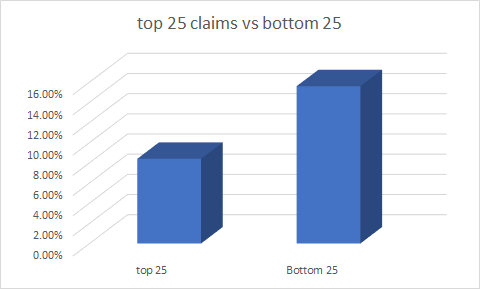
In reviewing the most recent unemployment claims, we find that the average of the top 25 for lower unemployment claims was 8.4% whereas the bottom 25 plus DC was 15.6%.
Both Utah and South Dakota never imposed a shelter in place and partially reopen their economy quicker. For the past four weeks, Utah and South Dakota averaged 5.8% and 6% unemployment and they had ranges from 5.3% to 6.3% over the past four weeks. New York and Michigan which had stricter shelter in place and have been behind in opening their economy. New York has averaged 21.25% unemployment claims and Michigan has averaged 21% over the past four weeks. These states had ranges from 20.3% to 22.5% in unemployment claims.
I then compared unemployment claims between two Red States, Texas, and Florida with two Blue States, New York, and California. California had unemployment claims ranged over the past four weeks 12% to 26.4% compared to Florida ranges of 5.7% to 22.4%. Both states have not yet seen a defined pattern but overall California has averaged 18.5% unemployment claims for the past four weeks versus Florida 11.1%. Florida has begun their reopening sooner and California is still struggling with designing a reopening plan. Florida overall unemployment claims are lower and both states are similar to death per capita with California slightly lower.
Texas and New York have had more consistent ranges and Texas unemployment claims have averaged 9.8% vs. New York 21.21%. More importantly, Texas has the lowest death per capita than the other three states and both Florida and Texas overall death per capita is significantly lower than California and New York combined. The trend within Florida and California is hard to digest but Florida economic numbers appear to be better than California and Texas have one half of the unemployment claims than New York.
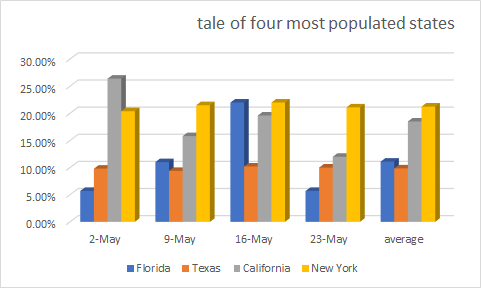
19 of the top 25 states are states with Republicans governor even though one of those states, Maryland can easily be categorized as a Blue State and both Kansas and Montana, two states with Democratic governors can easily categorized as Red States. The top seven in lowest unemployment claims are Red states run by Republicans. We have seen that among four of the most populous states, the Red States have nearly one-half of the unemployment claims than two blue states just as we have seen top 25 states are one-half of the bottom one-half states.
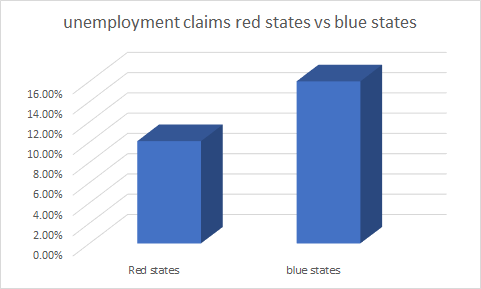
States with Republican Governors average 10% unemployment claims compared to 16% in Blue states. While unemployment claims may not equal unemployment rates, there is no doubt that by reopening states earlier and not having a shelter in place did less damage to various state economies. One conclusion we can make is that those states that open up sooner plus those few states that never activated a shelter-in-place had less unemployment claims.
The number one lesson is that shutting down the economy has a far more negative impact on the economy than keeping the economy partially open. This lesson needs to be heeded if we hit a second wave later in the year.
The second lesson is that the number one priority of state and local officials is to concentrate efforts to reduce the death rates among the seniors and those with co-morbidity, encourage the most vulnerable to protect themselves by staying in shelter, wearing mask and encouraging social distancing. I will estimate that we would have reduce the overall morality rate by at least 25% and maybe closer to 50% had states followed those strategies across the board from the beginning. Those who are the least vulnerable should be allowed to work.
When we do have a vaccine available, those over 55 with co-morbidity get vaccinated first.
While I can’t judge exactly what the unemployment rates would be but I will guess that it would be between 7 to 9 percent and if we followed the Florida strategy of dealing with the virus, we could have saved at least 23,000 to 48,000 lives.
This analysis is just a beginning and there is more data to collect including hospital utilization rates and its impact on other aspect of health care. What has yet to be measured is the impact on the overall health care system as many “non-essential” services have been first been prohibited and then delayed. This has led to lay offs for many hospitals and medical centers while delaying medical care for serious treatment of other ailments. How many patients have died of heart attacks due to lack of treatment, how many illnesses left untreated from cancer to heart disease will shorten life? There have been report of increase suicides as result of the economy’s decline. These impacts also need to be reviewed and if we reduced the number of seniors dying, we not only reduced hospital utilization for Coronavirus but also allowed other disease to promptly treated. Others can follow up on my own theory that a different strategy would have saved many businesses from being shut down, reduce unemployment, and reduced overall deaths to Coronavirus. And if my theory is correct, then we must use a totally different strategy if we have a second wave later this year or early next year.
Recovery in partisan crosshairs; New conspiracy evidence; China fighting back! By Dr. Larry Fedewa (Washington DC, May 24, 2020) – As if quarantine and recovery were not enough to worry about, Americans have other headlines competing for our attention. Most tiresome is the conflict between those who want to resume economic activity as much as possible and those who don’t. At issue is the frustration experienced by everybody at the lifestyle we have been forced to adopt because of the threat of the COVID-19 pandemic – everybody staying home while their jobs and earnings dwindle away.
Recovery in partisan crosshairsA vocal minority has rebelled openly against the closed-door policies of many jurisdictions which have been slow to authorize the back-to-work recommendations of the President. Some are claiming that these restrictive mandates violate the basic rights guaranteed by the Constitution. Others are desperate for an income, still others are just tired of the inactivity. None of this is too surprising given the circumstances. The surprising part comes when many leading Democrats began advocating the stay-at-home crowd, claiming that the plague is still too widespread to admit the proximity of daily life encounters in businesses and churches. They blame President Trump for sloppy management of the national response, apparently because he has instituted a “go-local” approach economic recovery.
They claim that there should be a “one size fits all” federal policy for the recovery, even though there is a vast disparity between the various local circumstances. This is not really a credible solution to the problem of managing the national opening of doors. But it gets serious when the House of Representatives passes a bill aimed at financially supporting the closed economy in the name of public safety from the virus. How do you deal with ridiculous proposals which are advanced by one of the highest authorities in the land?
New conspiracy evidenceThen, just when we are beginning to deal with that idiocy, we find out that President Obama may have been intimately involved in the attempted overthrow of his successor. The Dems are losing their minds over this one. The current administration has released some very incriminating documentation of testimony kept hidden for as long as two years by Adam Schiff, Jerrold Nadler, and Nancy Pelosi. These documents in effect begin to substantiate the assumptions of the President’s supporters that the attempted coup d’état which led to the impeachment trial of Donald Trump was in fact a treasonous conspiracy to overthrow the legitimately elected President of the United States.
China fights backThis is very serious stuff, but it is hard to concentrate on it when you are facing financial ruin because of a lost job or business. But if you are able to devote sufficient attention to these two political issues, there’s still another one brewing which is equally important but just about, as they say, “a bridge too far”.
This is the mounting tension between the USA and China. The war of words is getting more and more aggressive. More importantly, the Chinese are increasing their military threats to American shipping and air surveillance. Unless cooler heads prevail on both sides, this is the kind of rhetoric that can lead to war.
America is already taking on many of the policies which characterized our Cold War with Russia for two generations. But China is a different opponent. It is better positioned to engage in an economic and diplomatic rivalry not only because of the leverage of its huge market, but also because it is much more familiar with the intricacies of the American corporate and technological infrastructure, having worked closely with American firms and government departments and personnel (including Joseph Biden and family) for the past forty years (since the collapse of the Soviet Union).
Those relationships are wide and deep, including not only corporate partnerships but also generations of Chinese students educated in American universities, as well as the capture of America’s technological base, and the purchase of US public debt.
We do not want this cold war to turn into a hot war not only because of the tragic cost to all concerned, but also because it is not at all clear that we would ultimately win such a war. China’s space and long range weapons technologies are arguably superior to our own, especially since, unlike China, we have not been preparing for war over the past two decades and in fact let our military capacity deteriorate to an alarming extent during the Obama years. The Steve Bannon hawks need to think through again their anti-China positions before someone starts shooting. Yesterday’s fall of Hong Kong may be just the provocation to precipitate Western action. Things are getting very tense.
What can you do?So, that is the menu of top issues facing America. The question is, how do we deal with all these problems? Do we just decide to let the powers that be resolve everything? Do we pick a cause and go all out to support it with demonstrations, social media campaigns, and all the modern communications technologies?
There is an ancient prayer which includes the words,” Lord, give me the strength to accept things I cannot change, the courage to change the things I can, and the wisdom to know the difference.” Good advice in these troubled times.
Look past the words at the actions By Dr, Larry Fedewa(Washington DC, May 17, 2020) – As the saying around Washington goes, “President Donald J. Trump frequently steps on his own message”. Nowhere is that observation more accurate than in the matter of his leadership during the current crisis. His verbal descriptions of the steps he has taken and the reasons for each step sound a lot like bragging – even, at times, a plea for credit. But in few cases do they clearly and accurately convey either the obstacles or the strategy that led to these decisions – both of which have been significant.
Let’s do a brief recap. The COVID-19 pandemic has thrown the country into the worst crisis since Pearl Harbor. The President started our national response virtually alone. As the crisis began to take shape, he enlisted the aid of the public health experts, the national laboratories, the privately-owned laboratories, then the hospitals, the manufacturing industry, and so on, as new requirements arose, one after the other.
When called upon, these Americans put aside their personal feelings and opinions about politics and proceeded to perform nearly miraculous feats –as when the Army Corps of Engineers created a hospital in Central Park in three days!
What inspired this sensational cooperation? Trump’s mixture of salesmanship and pressure. The appeals of the President to the patriotism of the participants would not have been sufficient to effect the desired outcomes had the President not presented each group with specific, well-thought-out tasks which fit the capabilities of each party. This is called detailed planning.
The result was that each party was asked to do something they knew how to do and were capable of doing. And, in problem after problem – from medical supplies to hospital beds to pharmaceuticals to supply chains to manufacturing — the results were astonishing.
Then the President organized the governors of the 50 states and the territories into the most important role they have ever played as a group – perhaps in American history! Even the bitterest critics of the President joined the coalition and developed a working relationship with the federal administration and the President and Vice President (a former governor).
We witnessed the greatest example of federalism in the history of the Republic – James Madison would have been proud the see it in action. And there were also side effects of this strategy.
First of all, it was the most practical solution to the extremely complex problems of a national recovery which featured thousands of varying local circumstances and conditions. Clearly, the Democrats’ call for a “national” one-fits-all policy would not work.
But that observation reveals another side effect. By sticking to the Constitution, the President’s approach also made those criticisms of the opposition so obviously misguided that even the friendly Press disregarded them. In all, we saw the most impressive example of presidential leadership perhaps since Franklin Roosevelt in 1933.
The Press, of course, missed this amazing spectacle which was unfolding before their very eyes. For the most part, those eyes were blinded by the same unthinking bias which had caused them to join the Dems’ insane attempt to overthrow that presidency earlier this year.
I have commented in the past that other speakers, such as Vice President Pence, frequently describe the President’s actions more clearly and convincingly than does the President himself. However, the forum does make a difference. The President is very effective during his famous rallies in describing the mountains he has climbed as president and the results he has achieved. In fact, his ability to attract and entertain thousands of people in his rallies is unparalleled in modern politics. In this realm only entertainers can compete. This ability is so unique that any discussion of Donald J. Trump’s communication skills must begin with his rallies. Next would be his set speeches which have improved with practice and since he learned to use the teleprompter. Finally, would be his impromptu press briefings on his way to the airport. But his formal press conferences not so much.
(Washington DC, May 11, 2020) There appear to be two major stories contending for coverage by the press and the attention of Congress at the moment, both related to the COVID-19 pandemic: the economic recovery and the culpability of China in the escalation of the coronavirus from a potentially local tragedy to an international pandemic.On the one hand, the USA faces an almost insurmountable challenge to restore our recentlybooming economy from the depths of a Depression-like crash. On the other hand is the primal need to find a culprit for all the pain, sorrow, and deprivation we — and the rest of the world — havesuffered in fighting this evil scourge and to punish that source accordingly. The issue at hand is how to accommodate both needs at the same time.
This issue arises because the two factors are on a collision course. The facts are increasingly obvious. While the federal government appropriately pursues an intensive investigation of the precise sequence of events in the discovery and dissemination of this strain of coronavirus, evidence from outside sources is rapidly emerging that the Chinese Communist Party (CCP) consciously, deliberately, and with malice of forethought concealed from the rest of the world its early experiences with the outbreak of the plague and then schemed to spread the virus to all parts of the world. The motivation for this policy is not clear, although the working hypothesis is that the leadership was not about to suffer a severe economic catastrophe while the rest of the world looked on from the safety of having escaped the same fate.
The result of this news has been a surge of rage on the part of Americans, fueled principally by press accounts of these discoveries and speculation, some informed and some not so much.Responding to this national outrage, some Senators (the Republican Senate is in session and functioning while the Democrat House is still in its lengthy recess) have started proposing punitive measures against China. The attraction of this issue is obvious: it is emotional, not overly complicated and, most of all, potentially non-partisan. “Potentially” because there are close ties between leading Democrats, especially presumptive Democrat presidential nominee Joseph Biden,and China. In general, the Dems have been less aggressive on this issue than have the Republicans.
Compared to the progress in re-opening the American economy, the “blame China” issue is pretty straightforward. Economic recovery is proving complicated, spotty, and dangerous. The bestsummary comes from Governor Michael DeWine (R-Ohio), considered one of the most competent governors in the country.
“There is a risk in either direction”, says Governor DeWine. “The risk of re-opening the economy is the re-emergence of the pandemic. The risk of maintaining the strict mitigation is a prolonged Depression. So, my solution is to re-open CAREFULLY AND SAFELY.” (Fox News, 5/10/20). There are now emerging a number of second guesses as to what the Public Health experts recommended (as this column predicted on March 22 (see “Trump’s Huge Gamble”). Prominent among medical critics has been the idea that the “shelter in place” requirement should have been applied only to the most vulnerable, namely to those over 65, and all who suffer from “underlying conditions”.
Of course, these demographic details were not known when the shutdown was first announced. Little details like this do not stop the critics, however. Nor does the fact that immunity for young people does not appear as universal today as it once did. The most common critique is that adopted by some Democrats, namely, that the strict mitigation policies should be continued much longer. But there are many areas in America, mostly the less densely populated regions, which are in fact relatively untouched (so far) by the pandemic.
Thus, the recovery is spotty, uncertain, and carries its share of danger. But so does every alternative. Like Governor DeWine, most of America is slowly, carefully venturing out of our selfimposed quarantine. Except the elderly and victims of “underlying conditions”. It seems apparent that the overwhelming need and desire of Americans is to get back to work – in spite of the risks. The final judgement, of course, will come from the American people who will vote with their feet. There is enough without adding to them the risk of alienating China. There are reasons to put aside our worse fears and anger at the recent behavior of the CCP until this current economic disaster has been put in the rearview mirror. Some of the reasons are:
1) We are still in a major trade agreement with China to provide billions in exports, most notably from American farmers. In addition, many of the intellectual property issues — our most important reason for negotiating with China – are yet to be resolved. It is vital to our national interests to disengage our technologies and our supply chains from Chinese control.
2) China still holds a significant portion of America’s national debt ($1.05 Trillion as of February 15,2020). Although this holding represents a small percentage of America’s sovereign debt (5%), the Federal Reserve is going to market right now with an additional issue of several trillions of US dollars to cover the cost of the pandemic. This is not a good time to antagonize China into selling its US bonds at a discount just to make us suffer more.
3) China is a powerful, unpredictable rival for world domination. The Chinese also are very jealous of their international influence – and their massive financial stake in so many developing countries in Asia, Africa, and South America.
▪ A US assault on China’s international reputation must be carefully nuanced. It is not a time to be blundering about with blunt attacks which have a chance of provoking a military confrontation with China. For one thing, we cannot afford any wars right now – we are in a Depression, for heavens’sake.
▪ At this time, we are also arguably out-gunned by China in space and technologically advanced weaponry. For example, we are protected by a nuclear shield from Russia, North Korea, and Iran –but not from China. And China is parading missiles that will reach any major city in the USA.
Conclusion
Even aside from humanitarian considerations, this is not a good time for us to provoke China. It is a time to return to the rapport we had before coronavirus and conclude our trade talks, disengage our technology and our supply chains from dependence on China – and save our anger for another day.
By Dr. Larry Fedewa Washington DC, May 4, 2020 Fox News presented a “virtual Town Hall” program last evening featuring President Donald Trump answering videotaped questions for two hours. For those who have been catching the President’s daily news conferences, there was little new information. Apparently, the President’s assumption was that the audience had not been following the daily briefings. For those voters this was a status report on the country’s efforts to recover from the pandemic, both medically and economically.
Rather than attempt to summarize the status report – most of which is already familiar to those who follow the news — we will look here at whether the interview was an overall success or not.
The first item on that agenda is the President’s style. On the positive side, he reveals his command of the facts involved on a wide variety of issues. Equally important is his candor in admitting when he does NOT know something. Another characteristic which comes through is his sincerity. He clearly believes what he is saying – and it is this sincerity which allows him to connect with people.
On the other hand, he speaks in a sort of stream-of-consciousness style, which is well suited to his amazingly successful rallies but does not serve him as well when the question requires an authoritative response. His manner of speaking is entirely consistent with his overall approach to many of the issues he deals with. That is to say that he is a transactional thinker. He thinks in terms of negotiating each issue rather than in factual terms.
Thus, in answer to a speculative question like, “when will America return to normal?” his answer will be to list some of the elements of the prediction rather than giving a simple answer like “I think we will be back to normal by January 2021”. Instead, he starts thinking of all the elements which go into such a prediction, like: “Americans really want to get back to work. We are not meant to sit around waiting etc.” After surveying the main elements of the prediction, he finally opines that he expects the third quarter, 2020 to be transitional, the fourth quarter to be very vigorous, with a return to the booming economy by the beginning of 2020.
The effect of this style is frustration on the part of the listener. The President seems to be wandering all around the problem, touching on some points that seem irrelevant before finally stating – or not stating – a simple answer to what seems like a simple question. In his mind, he is reviewing all the possible items that might influence an action; he is “negotiating” with the questioner.
It is for this reason that several results occur: 1) he is hard to listen to when the questions concern results rather than the elements of an answer; 2) he is better judged on the basis of his actions rather than his words; 3) a more effective presentation of his accomplishments is done by others. This latter point was graphically illustrated last evening when Vice President Mike Pence and Treasury Secretary Steve Mnuchin appeared with the President in the last segment and explained the President’s accomplishments more convincingly than did the President himself.
Another aspect of the President’s transactional mode of thinking occurred near the end of the interview when he was asked about his intentions regarding tariffs on China’s imports. He indicated that the question was forcing him to explain his negotiating position prior to opening talks with China on the issue. In other words, like any good trader, he does not want to reveal his “hold card” (his true goals) in advance. It is often the case that only if the opposition is approached with no prior conditions will talks even commence.
I have noted this characteristic many times before, specifically in terms of his press relations. Reporters always want to know the goals of any negotiation before it even starts, obviously so that they can judge the results as success or failure. They don’t realize that such an approach to negotiations constitutes a set of demands rather than a negotiation. After all, prior to engagement, how does anyone know what might be agreed to in the final outcome. But the press just doesn’t get it. The bottom line is that President Trump likes to play his cards close to his vest – and the press hates him for it!
My conclusion is that President Donald Trump is better judged on results than on discussions. Let him tell his story in his own words at rallies and let others tell us about his accomplishments at town halls, virtual or otherwise. After all, in the end what counts is, “Promises made, promises kept!”
Through various studies, we are finding when including data from California, New York, Europe and Asia. The mortality rate is .1 to .8. anything over .1 is lethal than the flu and there are select vulnerable population that no doubt more lethal.
These are estimates but no matter, the lethal rate is far lower than presume. Let say we go with .5 rate. If 60 million are infected we are looking at 300,000 deaths worse case scenarios. 60 million is based on past flu seasons. Originally I guess that we could see 200,000.
At 200,000, this would be 1/10th of Spanish flu per capita. And at 200,000 it would be 50 to 100,000 worst flu season including 1957 Asian flu and 1968 Hong Kong flu. The real question do we continue to crash the economy and delay the reopening?
There are trade offs. We are talking 5 per 1000 vs the flu 1 per 1000. So to save those 4 from the virus, how many will die as result of economic downturn including increase suicides, starvation, delay treatment for health issues and drug overdoses?
Will it be more than the 4 per 1000 we are saving from the virus? Not an easy question to answer and the consequences from the economic downturn will be worse than continue lockdown. Your thoughts?
The present economic turndown is the fault of government policies not free markets. Government told businesses to shut down to stop the pandemic and as one meme goes, we had our 30 days of socialism, how did you like it? Yes, it was socialism and many governors and mayors has shown their inner dictatorship as they issued all kinds of rules and regulations, some of which contradicted each other. Many states are looking to reopen but others are not in a hurry, so we are looking at the nation rolling out over the next two or three months in phases.
Pandemics are not good for the economy and shutting down the economy may be looked at an extreme mistake down the road. The original data coming from China was there was nothing to worry about and many of our own scientists, who was giving advice to Donald Trump, didn’t fear the virus only to become fearful when we found out the Chinese were lying and World Health Organization proved to be their puppet. Original numbers showing high mortality rates with Italy at 10% scared many, but these data were based on incomplete data.
Jonathan Geach explained this further, “According to the Johns Hopkins coronavirus research center, COVID-19 has a CFR of about 5.7 percent in the United States. This means that someone who tests positive for the coronavirus has a 5.7 percent chance of dying of the disease. But this is not an accurate estimate of the fatality associated with COVID-19. Why? Because the sickest people are tested first, and many people who are and were infected with COVID-19 are never tested at all…To put this in perspective: Last winter 250,000 people tested positive for the flu. 25,000 died. If these numbers are right, the CFR for the flu is 10 percent … but that can’t be right…And, in fact, it isn’t. The Centers for Disease Control and Prevention (CDC) estimates that, although only 250,000 people tested positive for the flu last year, 39 million people actually got it. Generally, only those who are older or otherwise unhealthy, or those who have a severe case, go to the doctor and get tested for the flu; everyone else just takes Motrin and Tylenol and stays home. This drives up the CFR dramatically.”1
The present data was based on two things, the first is definition of Covid death was expanded and inflated the total and the second reason is that we were not counting mild or asymptomatic cases. Recent studies done including Austria, California, New York and Germany are showing morality rate between .1 to .8, underneath 1% mortality rate. At the lower range, it is similar to the flu and the upper range certainly higher than typical flu season or even the worse flu seasons. It is far less than 3 to 10% numbers often use and should leave policy makers wondering did we go too far. We used incomplete data and models that proved to be inaccurate by wide margins and some models revised as much as 20-fold downward to based policies on. Countries like Taiwan and South Korea showed the virus could be contain without sinking the economy and Sweden decided to not to shut down the economy and we are now witnessing an experiment on Swedish model versus the shutdown model.
There have been articles in which different standards used to report death to the COVID virus, so we may not have a complete accuracy of the numbers of the death. The new data show percentage of mortality is lower but while it is more lethal than the flu, but it is not SARS or even Spanish flu. Think of this way, flu will kill 1 out of thousand people while Covid-19 virus may kill 5 out of thousands. As Geach noted, the 5.7% number used is inaccurate based on incomplete numbers. The Spanish flu may have killed 25 to 50 out of thousand, so we are far below the numbers of the Spanish flu, but policy makers are treating this as if we are treating the Spanish flu or worse, SARS. This have to be included that in our economic decision. As someone who has polled hundreds of thousands, I view much of the data collection the equal of polling a state but polling only 50 percent of the state or less. A candidate pollster who did this would be providing his or her candidate an incomplete picture and this could cost an election. Policy makers are basing data on incomplete data while not looking at the economic data.2
Economist Casey Mulligan estimated, “that the shutdown of nonessential businesses reduces market production by almost $6 trillion per year of shutdown. Relief efforts further reduce the current value of future economic activity by about $2 trillion per year of shutdown. Black markets and additional time in the nonmarket sector replace about $2 trillion of the $8 trillion of lost market production. I estimate that the value of nonmarket production falls below what it would be if the normal market inputs were available by about $1 trillion per year of shutdown. The sum of these puts the welfare costs at about $7 trillion per year of shutdown.” He added that we are looking at either budget cuts or increase taxes nearly 2 trillion dollars to deal with the aftermath of this crisis.3
The key to recovery begins with medical innovation which it is estimated that within a year, medical discoveries add more than trillion dollars. It is estimated by Mulligan that a Covid-19 vaccine would not only save lives but save 28 billion dollars for each working day once normal activity returns. The key in this Pandemics is that old rules of regulations has to be change. In a pandemic, the demand for the treatment or vaccine occurs in just a span of a few months. Mulligan suggests that entire population should be allowed to part of any later phrase trials. Or everyone is rolled into a phrase three. What needs to be asked, is the shutdown worth the economic costs and what if the economic cost more than the shutdown effort to save lives or even cost more. The cost to the economy is high and there has been significant damage one. Thus, looking at ending the shutdown with the goal of recreating a more normal economy may be necessity.
The lessons from the 1918 to 1920 Spanish flu was that pandemic had an impact on the economy but so did interventionist government policies. Federal reserve money pumping along with an economy that still had many features of the war economy in place including boards controlling industries and high tax rates. The situation today is similar with the Federal reserve pumping out money, a deep recession as result of government interventionist policies on a Federal and State levels. A Federal reserve study noted, “First, the pandemic leads to a sharp and persistent fall in real economic activity. We find negative effects on manufacturing activity, the stock of durable goods, and bank assets, which suggests that the pandemic depresses economic activity through both supply and demand-side effects. Second, cities that implemented more rapid and forceful non-pharmaceutical health interventions do not experience worse downturns.”4 The recovery from the 1920 recession came as result when Harding administration moves toward austerity accompanied by tax cuts and budget cuts plus tariffs and the recovery came in the second half of 1921. (Many economists would argue that the Harding’s tariffs were not a boost to recovery but an obstacle.)
We have seen how to recover from deep recession or depression, and it begins with free market policies and the relaxation of government policies. UCLA Cole and Ohanian research showed that the government interventionist polices of Hoover caused the Depression and FDR policies in his first term delayed recovery as the unemployment never went below 10 percent in the 1930’s. About Hoover policies, Lee Ohanian wrote, “conclude that the Depression is the consequence of government programs and policies, including those of Hoover, that increased labor’s ability to raise wages above their competitive levels. The Depression would have been much less severe in the absence of Hoover’s program.”5
Ohanian added, “Presidents Hoover and Roosevelt shared similar goals of fostering industrial collusion and increasing real wages and raising labor’s bargaining power. Hoover accomplished these goals during a period of deflation by inducing in dustry to maintain nominal wages, and by promoting and signing legislation that facilitated union organization and that increased wages above competitive levels, including the Davis-Bacon Act and the Norris-LaGuardia Act. Roosevelt accomplished these goals with the NIRA and the Wagner Act, both of which raised wages well above competitive levels while increasing industrial collusion.”6 Other theories included the Federal Reserve tightening money and contributing to deflation and other bad government policies also contributed including Hoover engaging in tax increases and increasing government spending. Hoover signed Smoot-Hawley tariff in which already high tariffs went even higher and set the stage for a trade war that choked off international trade. Hoover intervention in the economy set the stage for the great Depression.
Harold Cole and Lee Ohanian added, “There are two striking aspects of the recovery from the Great Depression in the United States: the recovery was very weak and real wages in several sectors rose significantly above trend. These data contrast sharply with neoclassical theory, which predicts a strong recovery with low wages.”7 FDR loosen monetary policy which helped but many of the New Deal program delayed recovery throughout the decades as output never matched what was seen before the Great Depression.
Obama recovery paled in comparison to the Reagan recovery even though unemployment was slightly higher at the beginning of the Reagan recession than the Obama recession. Obama recovery was far weaker than the Reagan recovery and present Democrat proposal features far more government interventionist and essentially socialistic. These policies are to the left of even the Obama plan. The key will be removal of the present government policies that is stunting economic growth, in particular on a state level. You need a private sector to grow to reignite the economy growth and one example was Reagan approach which unleashed the private sector and led two-decade growth. Democrats idea of raising minimum wages, and green new deals will not only suffocate the recovery but ensure a long economic downturn that will last for years.
Voters are divided on where to go as far as opening the economy In a survey in Michigan swing counties, 51% of the voters feared that feared our health care system would be overwhelmed versus 45% stating that job losses and economic devastation as more threatening. In Wisconsin 7th congressional district, 46% viewed the health care being overwhelmed as the greatest threate and 48% feared devastation of the economy. 57% in Michigan wanted restrictions reduced along with 50% in Wisconsin compared to 35% of Michigan voters along with 46% of Wisconsin voters wanting the restrictions continued. There is slight agreement that the economy should be reopened but undecided if the threat to our health care system or the economy is worse.
Rasmussen on April 16th reported 58% of voters nationwide fear the healthcare system being overwhelmed and 36% fear the economic consequences. 23% voters feel the economy needs to open up by May 1st, another 27th need to open up by mid-June but 33% states the government must decide it is the right time to open up the economy. Nationwide at this time, it is not universally accepted that it is time to reopen and they fear the virus more than the economic consequences 36% of voters state that it is time to reopen the economy but 49% disagree.
Another aspect of this is the foreign policy side. Rasmussen polls 47% of voters blame China whereas 42% blame Trump. Independent by a 49% to 36% margin blame China along with 71% of Republicans but 60% of Democrats blame Trump for the virus outbreak and its spread. In battleground states, we found nearly 60% of Wisconsin 7th district voters and 78% of Michigan swing counties blame China. These voters overwhelming supported the travel ban and voters also view impeachment as a waste of time.
The biggest lesson that should be learned is that human ingenuity when unleashed can go a long way to solve problems whether it is finding drugs off the shelve that can save lives or new tests to find the Coronavirus in five minutes. Our recovery begins when we recognize that free men and women can rise above the crisis and reinvent our country and planet. The longer the shutdown continues, the worse our prospects will be. Don Boudreaux and Alberto Mingardi wrote, “Today, though, rather than trying to stimulate activity in the wake of the pandemic, governments are aiming to stop it. And at this task, everyone must agree, governments are performing splendidly… Once the coronavirus is under control, restarting the economy faces many obstacles—especially social distancing. If we continue to remain at arms’ length from one another, we will hamper our natural “propensity to truck, barter, and exchange,” identified by Adam Smith as a key source of economic growth.”7 The challenge to policymakers is to restart an economy with many of its feature have already disappeared. Economy based on secure property rights along with free markets, can recover quickly if market prices and producers’ ability to profit are allowed.
Our present strategy is the complete opposite as many businesses are told not to produce and are restricted in not just how to produce, but even they are allowed to produce. Democrats future economic plan proposed by Joe Biden and the Democratic Congress is even worse as they will continue to control the economy on a national scale, expanding upon what many governors are already doing. The Green New Deal is not about saving the planet but is designed to transform the economy beginning with telling utility companies what energy sources they will use, what kind of automobile you can drive, size of your home and the elimination of businesses just as the fossil fuel industry. Raising the minimum wage beyond what the market will ensure that many on the bottom of the economic ladder will not get jobs or rehired and 15 dollars an hour is beyond much of what the market will charge.
Democrat governors have shown that on a local level they have moved beyond regulating businesses but also how individuals behave. While some recommendations make sense just as wearing masks and social distancing will reduce viral transmission, others are simply overkill just as Michigan outlawing planting gardens.
We have dealt with these issues with our last report, The Pursuit Economic Growth, as we detailed a series of goals and ideas to spread the economic growth through the Middle Class and urban centers. We pushed a series of reforms, creating an entrepreneur class to go with an investor class as well as tax reforms, budget reforms and trade.
Several principles for a future recovery must be adhere to. The first principles as stated by Don Boudreaux and Alberto Mingardi, “What we need is not more fuel pumped into the GDP machine but assurances that its internal processes aren’t blocked. Governments have purposefully stopped the economy. To get it moving again, we eventually must remove obstacles that keep individuals from participating in market processes, both as consumers and as specialized producers.”8
The market collapsed has put our ideas of putting an investor class in jeopardy and our plans to create an entrepreneur class is threatened by many Governors actions whose shutdown has already killed many businesses. So, we need to open up the economy and be rid of obstacles that will prevent many businesses from starting back up.
As I wrote about Democrats economic theory, “What is missing from this formula is the creation of wealth. How often during the 2012 election did we hear from Obama or Senator Warren that entrepreneurs didn’t build their business but government did through the creation of roads and schools; entrepreneurs and business merely were inventions of government policies as oppose to being created by entrepreneurs themselves. Businesses, say the democratic socialists, are to be servant of the government, contributing to what the government deems necessary… all of economics is a zero-sum game in which a producer of underarm deodorants are stealing food from hungry children and government must step in to guide businesses in the right direction while taking from the wealthy to share with the Middle Class and the poor.”9
We will see at least three trillion dollars deficits when this crisis passes, and this has proved a Donelson Thesis “that government positive policies will benefit an economy on the margins, if it allows the private sector to function and innovate. The ability of bad government policies to do great harm is massive.” As Don Boudreaux and Alberto Mingardi noted, “Today, though, rather than trying to stimulate activity in the wake of the pandemic, governments are aiming to stop it.And at this task, everyone must agree, governments are performing splendidly.”10 Government policies can be a blunt object and that blunt instrument that has close the economy and sent millions of people unemployed. When this is over, this may be seen as the worst mistake made in a generation. What is missing is a plan to restart the economy and while it is easy to stop an economy in its place, it is even harder to restart one and be rid of the government obstacles shackling the economy in place.
The goals begin with getting our economy started by opening the economy and the difficulty of running an economy in a pandemic is difficult, something seen in the Pandemic of 1918 to 1920 where output and economy activity slowed down. The Pandemic came on the heel of nation straddle with government obstacles, including war boards design to run the economy and high tax rates to pay for the war, left over from World War I and a Federal Reserve that first expanded monetary policy that produce inflation and then a severe recession that unemployment may have reached 15%. The recovery began when the economy was liberated, and the Pandemic eventually ended.
There most likely will be no V shape recovery that many predicted at the end of this year and into 2021. The right policy can produce a lasting recovery beginning with tax rates not raised higher but lower on businesses and individuals combined with removing the cap on the social security and Medicare tax (FICA) tax, which would raise taxes on the wealthy. We showed that if you lower FICA tax by 1% and remove the cap, it would raise 90 billion dollars per year.11
We talk about dealing the budget in our report, “The other part is what we already mention that we need to review both spending and regulations. Trump administration efforts to deregulate the economy is showing some benefit and regrowth by reducing the government impact upon the economy. On the budget side, no one can disagree that spending has substantially increased and there is very little stomach at this point to reform the entitlement program. Democrats are not only looking to expand entitlements including Medicare for all that would expand the entitlement program to almost all Americans so first battle may just be keeping the welfare state from exploding. The best strategy may be to review spending either by repeating what Republicans forced Obama to accept sequester to reduce the growth of spending or simply start reviewing departments and look for either elimination or cut back just as Department of Energy, especially since the fracking revolution has made the Department obsolete.” 12
Over the next few years, there will be little stomach for entitlement reforms, even they will eventually be needed. In an economic downturn, you will not get a consensus for any entitlement reforms, but we can begin with present budget and there is plenty to cut or reduce. Eliminate or reduce departments will not only reduce the budget but in many cases, be important in reducing regulations which will be a necessity to remove obstacles to growth.
Trump pointed out the weakness of globalization that the political class fail to see and understand that globalization can’t work with when rogue nations refuse to play by the rules, and they taking advantage of a virus and economy ravaged from their incompetence and lies. China has put our planet at risk and lives of billions due to their mishandling and now continues to lie about their role in the virus. China is the weak link in globalization, and we must recognize that.
China lied from the very beginning about the virus beginning in December and one study showed that if the Chinese had acted three weeks early, they could have stopped the virus from leaving China.13 China and WHO were telling the world middle of January that there was no human to human transmission, an outright lie and they allowed Chinese national to leave China after locking down Wuhan. This move helped to spread the virus.
The media has often reiterated Chinese talking points including how successful the Chinese have been even though anyone with any common sense would know Chines numbers are simply questionable if not bogus. A recent story that Chinese have closed movie theaters again and several reports escaping China about the numbers of bodies being cremated and riots breakouts between Chinese provinces as polices from different provinces fight for jurisdiction on stopping the virus. Many Asian sources that the total infection and death totals are significantly higher than being reported.14 One estimation puts the Chinese infected at conservatively nearly three million and death significantly higher.15 The news that US has surpassed China in total number has been treated as a Trump failure even though as mention, no serious journalist should even take Chinese numbers with a straight face. This regime unleashed the virus with their incompetence and even sold Spain and Czech Republic thousands of test kits.
The real test will be whether the United States uncouple itself from China? This won’t be as easy as many of our products are already manufacture there and to move them to United States would encompasses economic sacrifice. We will not be able to transfer all of our manufacturing back to the United States or even our NAFTA partners without economic costs. While some manufacturing can be brought back home including our pharmaceutical, we will need to find dependable supply chain. India was originally going to not export Hydroxychloroquine to the United States and keep the raw materials home for their own population but relented after a phone call from Trump. India stands to profit in the long run as becoming part of our supply chain and maybe replace some of what is manufacturing in China and this move may have been designed to show the rest of the world they can be depended upon.16 In my book “The Rise of National Populism and Democratic Socialism, What Our Response Should be,” I wrote, “. India, for many years, has set itself apart from the West, but in recent years, this is beginning to change. Gone are the days of reflective anti-American attitudes that infiltrated Indian leadership and there is a more balanced approach to world events. It will be imperative among American policy makers to encourage India to become a permanent member of the Anglosphere.”17
About trade policies, I wrote, “Throughout our history, it was not uncommon for American presidents to seek temporary economic rehabilitation against other countries to open up trade opportunities for American goods and services. Both President Reagan and President George H.W. Bush did this, putting “tariffs” on selected goods and industries from other countries. But their goal was to liberalize trade not to restrict it, and both presidents made sure these steps were temporary, and used as a means to open up trade and reduce barriers to American goods.” Free trade Presidents have been willing to use tariffs to open up trade.” 18
In the effort to decouple China will mean continuing trade troubles with the second largest economy and we will see tariffs on China goods, but it does beg the question where do we go to increase our markets? Many nationalists have promoted an industrial policy and some cases an autarky economic policy, but an industrial policy has its limitation since it puts the government in a position of picking winner and losers. However we do have options beginning with expanding the NAFTA to include Great Britain, New Zealand and Australia, into a giant Anglosphere trading bloc and begin to negotiate with European Union or European nations if the European Union collapses in the wake of the Virus pandemic. We can add to the trading bloc with Democratic European nations by adding South Korea and Japan. We may want to design strategies to help develop India as an economic counterweight to China as well as build up other nations like Indonesia as future economic partners. These moves will be more a managed trade but if it is liberalized trade beginning with Democratic and economic advance nations, we can make up for disruption of China trade.
The biggest challenge will be stopping the Democrat Party and the left socialistic plans to transform and control the economy. We are starting to see what a Democratic socialism government would look like and is it not pretty. If Trump loses, it will begin a socialistic governance in all, but name transformation and any recovery will be not only delay but never appear in the next decade, if ever.
The question facing policy makers when to open up the economy and what the cost will be if they don’t. We are getting an idea of the mortality of the virus and it is far less than originally supposed. With studies from Austria, Germany, New York, and California, we are seeing rates from .1 percent to .77 percent. The low range will be in the range of the flu and that higher number higher than the flu but far less than the Spanish flu. We are closing the economy for a virus that will kill between 1 out of 1000 to 7 out of 1000. If you average these studies have shown, you may be looking at .5 which means 5 out of 1000. The Spanish flu may have killed anywhere between 25 to 50 per 1000, which is between 5 and 10 times what Coronavirus and most of the death to the Coronavirus affects those with co-morbidity and over the age of 60 whereas the Spanish flu killed many young in addition to the elderly. This is not saying Coronavirus is similar to the flu, it is not, but it is not the Spanish flu and we may be talking 5 out of 1000 dying versus 1 out of 1000 with the flu. This is higher overall than the flu but if the economic downturn ends up killing more people through suicide, delayed medical care, starvation due to hunger or increase drug overdose, what is the overall benefit of saving those extra four lives?
The cost of the recession or depression could prove greater than the virus itself. For every 1 percent will produce 3.3 percent increase in drug overdose and nearly a 1 percent increase in suicides. This data comes from medical journal just as Medical Journal Lancet and National Bureau of Economic Research.19 Jonathan Geach added this, “The state of our economy is not just a monetary risk, it is a health risk. When people lose their jobs, they typically lose their health insurance. The British Journal of Psychiatry found that there were more than 10,000 “economic suicides” as a result of the 2008 recession. Similarly, a 2016 study from The Lancet found that there were an excess 260,000 cancer deaths as a result of the recession. These statistics also fail to mention the increased domestic violence, increased child abuse and home loss when schools and businesses are closed.”20 The unemployed and under employed will suffer the consequences and they are the forgotten Americans who paying the price for this experiment. If the cost is higher to induce a depression to stop a Pandemic, shouldn’t that be a consideration? It is not a case of open up and people die since more people most likely will die from the economic downturn. It is about making sure if there is American economy left to return to.
Models have been shown to be flawed and we are basing economic policy on these models. Many Models have been changed numerous times within a period of time to reflect new data but some of the original model were way off. One example of this failure was the predicted mortality for five Midwest States week ended April 22nd.
Iowa on April 11th was projected to have 743 deaths but by April 22nd, projection moved to 365 or cut in half. On April 22nd, Iowa had 107 deaths. South Dakota was projected to have 356 deaths before adjusted to 93, a significant readjustment and on April 22nd, the actual number was 10 and North Dakota and Wisconsin didn’t change much at all but the actual mortality for North Dakota was 15. There is a good chance that neither Dakotas will even hit their low estimate as far as mortality goes and Minnesota estimate dropped from 656 to 360, a drop of nearly half in one week. (Minnesota based their own plan based on estimate of 74,000 deaths but those numbers have long since been discarded but it didn’t stop Minnesota planners from using those numbers.) South Dakota has in the forefront of opening up their economy and didn’t impose a harsh shutdown.
North Dakota:
Iowa:
South Dakota:
Wisconsin
Minnesota
11-Apr
369
743
356
357
442
15-Apr
329
618
181
338
656
22-Apr
356
365
93
356
360
The inconsistency and often inaccurate nature of the models matters as Anthony Fauci noted that “There are things called models, and when someone creates a model, they put in various assumptions. And the model is only as good and as accurate as your assumptions. And whenever the modelers come in, they give a worst-case scenario and a best-case scenario. Generally, the reality is somewhere in the middle. I’ve never seen a model of the diseases that I’ve dealt with where the worst-case scenario actually came out. They always overshoot.” Maybe politicians and general public might become skeptical about those models dealing with predicting climate fifty years from now when we have difficulty accurately predicting within a week the mortality rate of a Midwest state.
Many of our experts, including those who advise the President, have themselves been wrong. Fauci and Birks admitted that they underestimated the virus and based their initial view on what WHO and China was telling them. Not only did they get it wrong about the virus virulence and how easy it was to transmits but they also were wrong in trusting the Chinese to begin, a mistake that Senator Tom Cotton who was one of the earliest to warn about the virus did not makeWe are told to trust the science but if the science is uncertain and evolving, how much trust can we put in the experts when they are still trying to grip with the virus? We need to be equally skeptical about Climate change alarmists who have based much of their data on models than can’t possibly include all of the data needed to make the decision of what our climate will be in 100 years from now much less five years down the road. Scientists have insight in their specialty, but doesn’t mean they are experts in other fields. Asking an epidemiologist about dealing with a Pandemic, he or she will give you solid data based on years of research. Ask the same individual the impact of economic shutdown he will be less likely to give you the downsize or the cost involved in shutting down the economy. When an economy sinks in recession or depression, it does have its own health risks and the risk of what we are presently doing may outweigh the benefits.
China is now a rival and we have seen what the world future will be like if the China is the number one power supplementing United States. It will be a less free, less prosperous world in which the United States will see not only an economic decline but overall decline in our basic freedom we take for granted.
China was responsible for the spread of this virus and there is even evidence, not yet proven, that the virus could have originated in the Wuhan Laboratory. For the past century, the sins of China have become obvious from building islands in the Pacific threatening the trading lanes, stealing our industrial secret, hacking into our government system, and threatening their neighbor. As for the virus, Chinese silenced whistleblowers and physicians who warned of the virus and allowed Chinese national to leave the country during the initial phrases of the virus outbreak.
Chinese have been building their military and much of their data is done in a way to hide the true nature as journal Defense One noted, “An early lesson emerging from China’s handling of the COVID-19 emergency is that Beijing still manipulates data to fit its desired narrative. This has long been the case in China’s defense budget, where the party-government omits and withholds data to project a non-threatening image of its People’s Liberation Army. However, there are ways to cut through some of the mangled information…If you account for differences in reporting structure, purchasing power, and labor costs, you find that China’s 2017 defense budget provided 87 percent of the purchasing power of American’s 2017 defense budget…Further complicating accurate comparisons are the unique characteristics of China’s party-run military, such as military-civil fusion, usage of state-owned enterprise, theft of intellectual property, and the embedding of party organizations in private companies. Some of these elements, even if known, are simply unquantifiable. Thus, if we seek to compare the resources Beijing dedicates to defense with what other countries are doing, our only recourse it to remove all military R&D from the calculations.”21
About China Naval Congressional Research Services concluded. “In an era of renewed great power competition, China’s military modernization effort, including its naval modernization effort, has become the top focus of U.S. defense planning and budgeting. China’s navy, which China has been steadily modernizing for more than 25 years, since the early to mid-1990s, has become a formidable military force within China’s near-seas region, and it is conducting a growing number of operations in more-distant waters, including the broader waters of the Western Pacific, the Indian Ocean, and waters around Europe. China’s navy is viewed as posing a major challenge to the U.S. Navy’s ability to achieve and maintain wartime control of blue-water ocean areas in the Western Pacific—the first such challenge the U.S. Navy has faced since the end of the Cold War—and forms a key element of a Chinese challenge to the longstanding status of the United States as the leading military power in the Western Pacific.”22
China military buildup is connected to their economic rise and attempt to become the new world superpower in the world. The implications are clear what this means to the rest of the world. When an NBA general manager tweeted out support for Hong Kong, the Chinese made it clear to the NBA that their millions if not billions of dollars of business would be at stake. The NBA surrender to the Chinese, even to the point of removing protester for Hong Kong who showed up at NBA games were removed. Hollywood censor their own movies that enter the Chinese market and many within the entertainment business self-censor themselves in regard to China. Many of the NBA social warriors not only refuse condemn China but they even went as far as to defend China and their multi million dollars contract. What we witness is a taste of what the world would look like if China is the Superpower of the world. Many of our own institutions are already restricting what they say about China and the number of media personalities have defended China own behavior in this crisis. Those companies who own the major networks just as the big Three, ABC, CBS and NBC do significant business and it has produced a more favorable view of China in those media. New York Times and the Washington Posts have run inserts from the China Daily, and who knows what they receive in payment for publishing Chinese propaganda.
Arthur Bloom gave in a recent piece examples of this control, “Disney owns ABC and has a park in Shanghai. It also owns ESPN, which was criticized for its coverage of China’s retaliation against the NBA earlier this year over one team owner’s support of the Hong Kong protests. But other than ABC, Disney is relatively uninvolved in news…Comcast, on the other hand, has a much larger footprint in the U.S. media landscape, between NBC News, CNBC, and MSNBC. The company’s role in fostering cultural exchange is truly historic: they’ve brought to millions of American homes a customer service experience akin to a utility provider in a communist country, and have invested billions to bring “Minion Land” and a Harry Potter village to Beijing, with the help of a state-owned investment vehicle.”23
China influence is already being felt within our body politics and this is just the tip of the iceberg of what will happen if China is the Superpower of the World supplementing the United States. As mention a dark cloud will move over the world and the decline of freedom to go with decline our economic fortunes will arise.
Summary
The present Coronavirus crisis has produced an enormous crisis for America and the conservative movement. Based on initial threat of the virus and attempt to flatten the curve, we shut down our economy and, in the process, put this election in jeopardy. This article is attempted to make sense of this crisis while reviewing the history of both economic recoveries from Recession or Depression and the impact of Pandemics.
Among the things we should conclude:
Pandemics by themselves have impact on the economy and this Pandemic would have produced a negative result on the present economy. In hindsight, we could have done what the Swedes did, keep the economy open and reduced the damage done to the economy.
Conservatives need to understand that the left will use this crisis to further their own goals of transforming American into a “Democratic Socialist” state. Joe Biden has moved to the left and will be a mere puppet in his own administration, controlled by the socialist wing of the Party.
We need to make the case that free market ideas are the best way to recover quickly and have our own game plan to do exactly that including tax plans, budget plans, and ideas on both trade and regulations.
China has shown itself to be a threat and we need to design new alliances to counter this threat along with trade policies that extends to our Democratic allies throughout the world.
Many within our own country has allowed their own economic interest to cloud their judgement about China including the Media.
Finally, design plans to ensure that we will be ready for the next Pandemics and hold China responsible for this one.
Ronald Reagan summed up its best, “Freedom is never more than one generation away from extinction. We didn’t pass it to our children in the bloodstream. It must be fought for and handed on for them to do the same, or one day we will spend our sunset years telling our children and our children’s children what it was once like in the United States where men were free.”
Footnotes
Mapping the Mortality Maze, How Deadly is Covid-19 Jonathan Geach, Ankur J. Patel, Lacy Windham Ashkan Attaran and Jason Friday. American Spectator April 25, 2020
Economic activities and Medical innovation during a Pandemic. Casey Mulligan
Pandemics Depress the Economy, Public Health Interventions Do Not: Evidence from the 1918 Flu Sergio Correia, Stephan Luck, and Emil Verne
What or Who Started the Great Depression. Lee Ohanian UCLA and Federal Reserve Bank of Minneapolis
New Deal and persistence of the Great Depression Harold Cole and Lee Ohanian May 2001 Minneapolis Federal Reserve
The Economy Is Not A Machine by Don Boudreaux and Alberto Mingardi April 20, 2020 The City Journal
The Rise of National Populism and Democratic Socialism, What our response Should Be?” Tom Donelson chapter Democratic Socialism
The Economy Is Not A Machine by Don Boudreaux and Alberto Mingardi April 20, 2020 The City Journal
Tax and Social Security in the New Paradigm by Tom Donelson Americas Majority Foundation. 2019 Pursuit of Wealth Creation 2020 by Tom Donelson, JD Johannes, and Clara Del Villar
Effect of Non-Pharmacological interventions for containing COVID-19 University of South Hampton
Business insider, US intelligence found China misrepresented Coronavirus state report April 1st, 20202
Estimating the True Numbers of China Covid-19 Derek Scissors AEI April 7th, 2020
Hydroxychloroquine consignment from Arrives in US. April 12, 2020 Times of India
The Rise of National Populism and Democratic Socialism, What our response Should Be?” Tom Donelson chapter the Rise of India and Anglosphere
The Rise of National Populism and Democratic Socialism, What our response Should Be?” Tom Donelson
We must count the deaths from the Shutdown as well as COVID Betsy McCaughey New York Post April 14, 2020
Mapping the Mortality Maze, How Deadly is Covid-19 Jonathan Geach, Ankur J. Patel, Lacy Windham Ashkan Attaran and Jason Friday. American Spectator April 25, 2020, Medium Moving the Goal Posts, Four Reasons to Safe to Open Up America. April 16, 2020.
China Defense Spending Bigger than it Looks Frederico Bartels, March 25, 2020 Defense One.
Congressional Research Center, China Naval Modernization: Implications for US Naval Capabilities. March 18, 2020
China Long Tentacles Runs Deep into The Media Arthur Bloom, American Conservative March 31st, 2020.